
The word medieval can often conjure up in our minds a time rife with extreme poverty, war and plague. A period with perhaps very few redeeming features. Put aside the Mediaeval period as occasionally represented by Hollywood, this period of musical history lasting for around 900 years, was rich with invention, discovery and creative insight. In our programme today, Phil and I take a brief look at some key composers of this fascinating period and which, hopefully, will inspire you to delve further into the colourful world of Medieval Music.
Notker Babulus (c. 840 – 912)
Notker the Stammerer (or simply Notker)
Occidentana
Ordo Virtutum
Hildegard of Bingen (1098 – 1179)
Spiritus Sanctus Vivificans
Anna Sandström (soprano)
Christopher Monk
Giraut de Bournelh (1138-1215)
Leu Chansoneta
Martin Best Medieval Ensemble
Guillame de Machaut (1300-1377)
Messe de Notre Dame: Kyrie
Ensemble Organum
Marcel Pérès (conductor)
Anonymous
Montard Brawle
The Henrician Consort
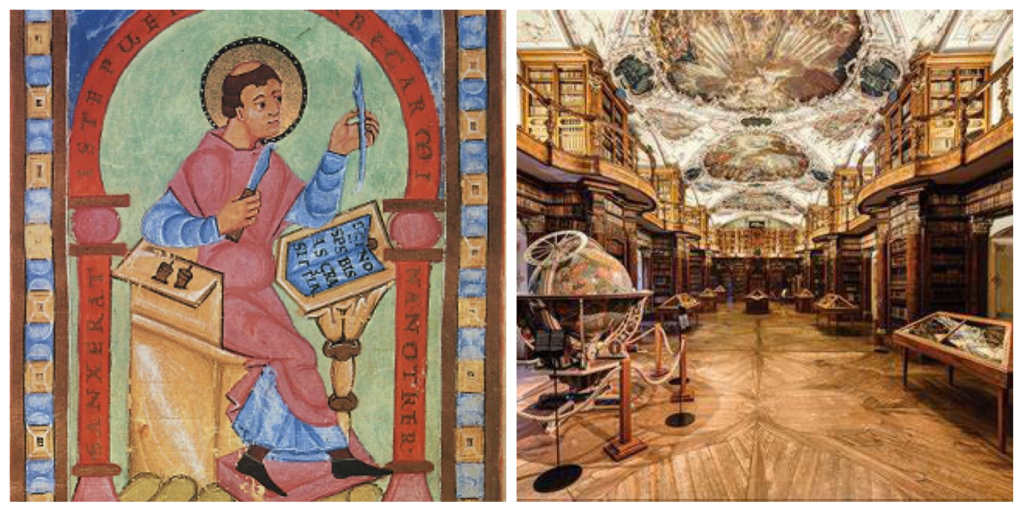
Notker Balbulus was a Benedictine monk at the Abbey of Saint Gall and was active as a composer, poet and scholar. He was educated alongside the monks in Abbey of Saint Gall who were also composers. Their work made the Abbey an important center of early medieval music and the famous St Gall Abbey Library provides a home for manuscripts which are vital, not only for specialised research into the liturgical music at St Gall, but also for general research into the Medieval period. Occidentana is part of this collection which also includes examples of early repertoire relating to Gregorian chants.
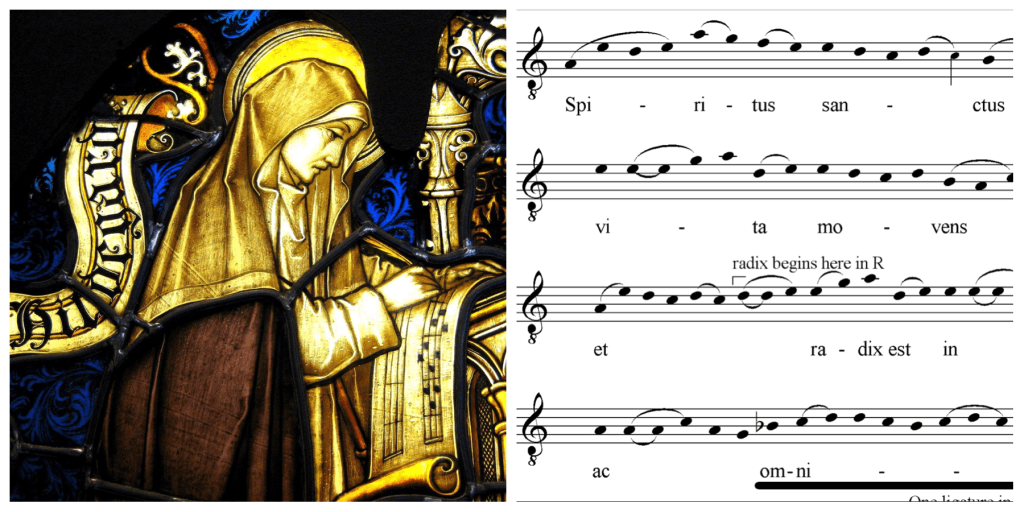
Hildegard of Bingen was a German Benedictine abbess and polymath, active as a writer, composer, philosopher, mystic, visionary, and as a medical writer and practitioner during the High Middle Ages She is one of the best-known composers of sacred monophony, as well as the most recorded in modern history. She is considered by scholars to be the founder of scientific natural history in Germany. Hildegard also wrote theological, botanical, and medicinal works, as well as letters, hymns, and antiphons for the liturgy. There are more surviving chants by Hildegard than by any other composer from the entire Middle Ages. One of her works, the Ordo Virtutum, is an early example of liturgical drama and arguably the oldest surviving morality play. Spiritus Sanctus Vivificans is a Psalm antiphon for the Holy Spirit

Giraut de Bornelh was a troubadour connected to the castle of the Viscount of Limoges. About ninety of Giraut’s poems and four of his melodies survive. His work was held in high esteem and he would have sang at important ceremonies and royal occasions. Troubadours very often went with their masters when they went on journeys to battles and it is thought Guiraut might have accompanied Richard I of England and Aimar V of Limoges on the Third Crusade.

Guillaume de Machaut is regarded as the most significant French composer and poet of the 14th century. Machaut has an unprecedented amount of surviving music, in part due to his own involvement in his manuscripts preservation. He embodies the culmination of the poet-composer tradition stretching back to the traditions of troubadour. Machaut’s poetry was greatly admired and imitated by other poets, including Geoffrey Chaucer well into the 15th century. Machaut composed in a wide range of styles and forms and he was crucial in developing the motet and a variety of secular song forms

There were two main types of dances in medieval times: line dances and circle dances. The bransle was a round dance or circle dance. The word bransle comes from the French word branler (to sway) and is pronounced Brawl. Other dances were the basse dance and estampie.

Leave a comment