Ghosts and the supernatural have always attracted classical composers. Grieg’s In The Hall of the Mountain King is where a crowd of gnomes and goblins gather before their troll king. Saint-Saens Danse Macabre takes place on Halloween night and death plays a fiddle enticing the skeletons to crawl out of their graves for a dance party. Tchaikovsky (Hamlet), Stravinsky (Petroushka), Schumann (Haunted Place), Richard Strauss (An Alpine Symphony) and Dvorak (The Spectre’s Bride) have all been inspired by the supernatural
Richard Wagner
The Flying Dutchman
London Philharmonic Orchestra
David Parry (conductor)
Wolfgang Amadeus Mozart
Don Giovanni Act II, Scene 19
Bryn Terfel (bass-baritone)
Michele Pertusi (bass)
Mario Luperi (bass)
London Philharmonic Orchestra
Sir Georg Solti (conductor)
Ralph Vaughan Williams
The Lovers Ghost
Coro
Mark Griffiths (conductor)
William Bolcom
Three Ghost Rags: No 2 The Poltergeist
Marc-André Hamelin (piano)
Hector Berlioz
Symphonie Fantastique: Witches Sabbath
Boston Symphony Orchestra
Seiji Ozawa (conductor)
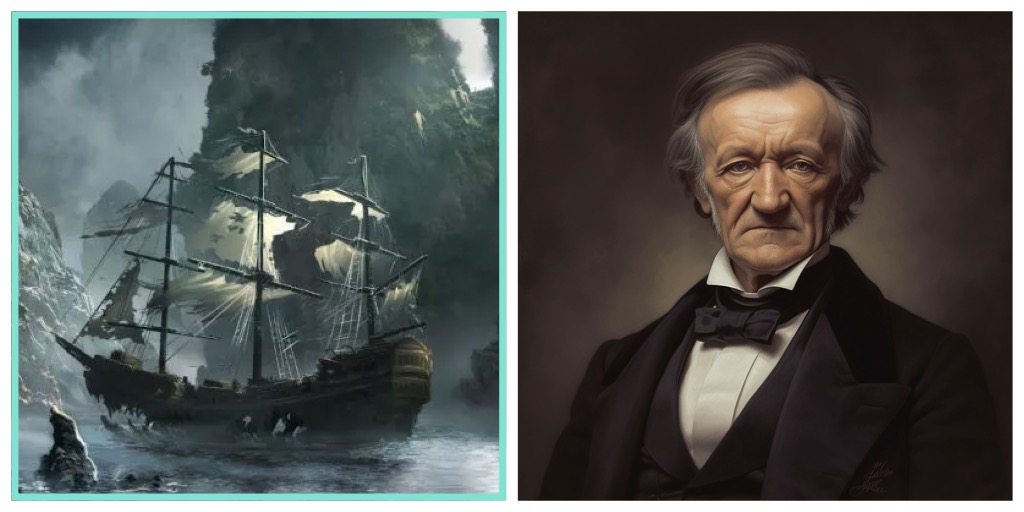
A Dutch sea captain is condemned by the devil to sail the seas until he finds a woman who will declare herself faithful to him until death. The Dutchman finds a girl but suspects she is cheating on him so sets sail again without her. Distraught, the girl rushes to the cliff and leaps to her death declaring her love for the DutchmanThe ghost ship sinks and the Dutchman is released from the curse. This dramatic tale is an early work in Wagner’s life and he is developing the idea of leitmotifs (a short recurring musical phrase associated with a character, theme, place, or object). Other composers at the time were also exploring using leitmotifs (Berlioz for instance) but Wagner’s influence still remains today as film composers often use leitmotifs to identify important characters in a film, most notably John Williams (Star Wars, Harry Potter)

The womanising Don Giovanni isn’t a good guy, but he drives the action in Mozart’s opera of the same name. Don Giovanni’s servant keeps a list of how many women Giovanni has seduced in various countries, (1,003 in Spain alone). The arrival of a vengeful ghost very late in the opera is one of the most dramatic moments in opera. The ghost is The Commendatore who comes to demand repentance by Don Giovanni, Don Giovanni refuses so is taken off to hell as retribution. The music by which he appears is some of the most formidable Mozart ever wrote and any listener accustomed to the grace and good cheer of Mozart’s usual style will be shocked by the grim and somber mood of this dramatic scene

A century ago traditional song was rapidly falling into obscurity, and it is very largely owing to the work of Ralph Vaughan Williams and other collectors such as Cecil Sharp that this material was preserved and revived. The Five English Folk Songs date from 1913. The first four songs tell of the traditional themes of love found and lost and the last is a rollicking celebration of good cheer.
The fourth song, The Lover’s Ghost, is derived from a 17th-century story called ‘A Warning for Married Women’ and tells the story of Mrs. Jane Reynolds who, engaged to a seaman, eventually married a carpenter. For her infidelity a dark spirit sinks the ship she had boarded and the unfortunate Mrs Reynolds is carried away to Hell. Vaughan Williams sets only part of the ballad, so much of the narrative of the story itself is lost

William Bolcom is a master of musical fusion whose music uses elements of classical traditions, ragtime, jazz, country, Broadway music and other styles. Strongly influenced by two of his teachers, Darius Milhaud and Olivier Messaien, Bolcom composed Three Ghost Rags in 1971, next to a graveyard in New York. Ghost Rag No. 2 is entitled Poltergeist and dedicated to Tracey Sterne, who pursued a career as a concert pianist but eventually masterminded Nonesuch, the record label highly regarded for its diverse catalogue of music and composers. Bolcom dedicated this music to the memory of his father, who he often ‘felt hovering around my piano while I played at night.’

Berlioz would have been about 27 years old when this was written, and it’s the composition he’s most known for. Symphony Fantastique is one of music’s first drug trips as not only does the story itself involve opium, it’s thought that Berlioz composed some of it while being under the influence of opium himself. The symphony was Berlioz’s breakthrough work and he went further into uncharted territory than even Beethoven. The influence of opera is also clearly felt in this symphony, with the epic storyline that explores everything from hallucinations to witches to love. Not only is it unusual in having 5 movements, the music is far more intense and frightening than anything else from the era.


Leave a comment