
J.S.Bach (1685–1750)
G.F. Händel (1685–1759)
Antonio Vivaldi (1678–1741)
G.Ph. Telemann (1681–1767)
Domenico Scarlatti (1685–1757)
Bach and Handel, both born in 1685, were aware of each other’s work but never met in person.
Bach and Vivaldi never met in person as Vivaldi led an international lifestyle, travelling extensively and gaining widespread recognition whilst Bach remained mostly in Germany, focusing on his work and family.
Bach and Telemann knew each other and had a significant relationship.
They were not only contemporaries but also friends.
Bach and Scarlatti, both born in 1685, did not meet in person.
While they were contemporaries and highly respected composers of the Baroque period, their paths never crossed.
This edition of In Conversation looks at five great baroque composers, all of whom were contemporaries of J. S. Bach
G.F. Händel (1685–1759)
Music from the Royal Fireworks; Overture (Allegro)
Tafelmusik Baroque Orchestra
Jeanne Lamon (conductor)
Antonio Vivaldi (1678–1741)
Concerto in D minor RV566
Europa Galante
Fabio Biondi (conductor)
G.Ph. Telemann (1681–1767)
Overture in E minor: Réjouissance
Freiburg Baroque Orchestra
Gottfried von der Goltz (violin and director)
Domenico Scarlatti (1685–1757)
Sonata in G Major K146
Michelle Benuzzi (harpsichord)
J.S.Bach (1685–1750)
Mass in B Minor, BWV 232: Cum Sancto Spiritu (Chorus)
The Monteverdi Choir
English Baroque Soloists
John Eliot Gardiner (conductor)
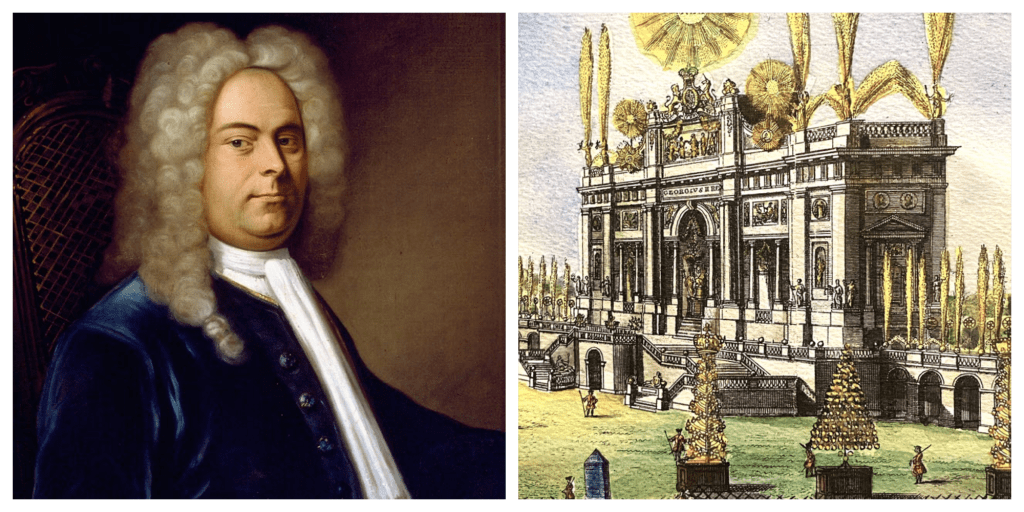
The Royal Fireworks Music, was composed for a celebration of the Treaty of Aix-la-Chapelle (marking the end of the War of Austrian Succession) on April 29, 1749.
It was to be a festive evening in London’s Green Park with a fireworks display to the accompaniment of Handel’s mammoth new suite.
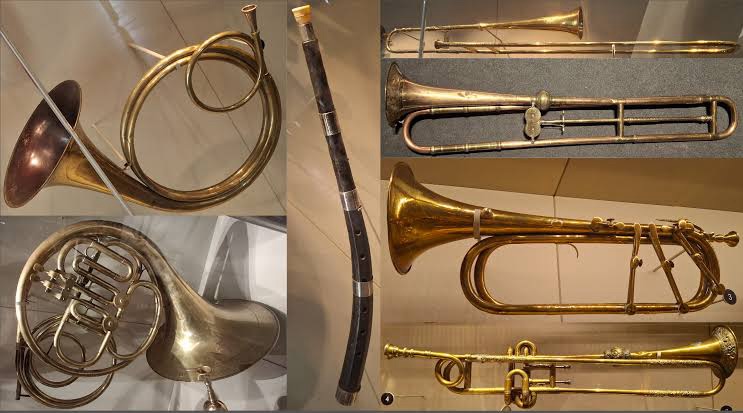
Handel scored the work for twenty-four oboes, twelve bassoons, contrabassoon, nine horns, nine trumpets, and six timpani requiring three players.
The structure from which the fireworks were launched caught fire shortly after the event began.
After the event, Handel decided to add strings to the suite in hopes of marketing it to the ever-curious public.
This also allowed him to transform his score into a superb addition to the concert repertoire.
Music for the Royal Fireworks begins with a rousing ‘Grand Overture of warlike instruments.’
Handel is well known for his operas, oratorios, anthems, concerti grossi, and organ concertos.
He received his training in Halle and worked as a composer in Hamburg and Italy before settling in London in 1712, where he spent the bulk of his career and became a naturalised British subject in 1727.
Handel brought Italian opera to its highest development, creating the genres of English oratorio and organ concerto, and introducing a new style into English church music.
Handel started three commercial opera companies to supply the English nobility with Italian opera.
After his success with Messiah (1742), he never composed an Italian opera again.
His orchestral Water Music and Music for the Royal Fireworks remain steadfastly popular.
One of his four coronation anthems, Zadok the Priest, has been performed at every British coronation since 1727.
Almost blind, he died in 1759, a respected and rich man, and was given a state funeral at Westminster Abbey.
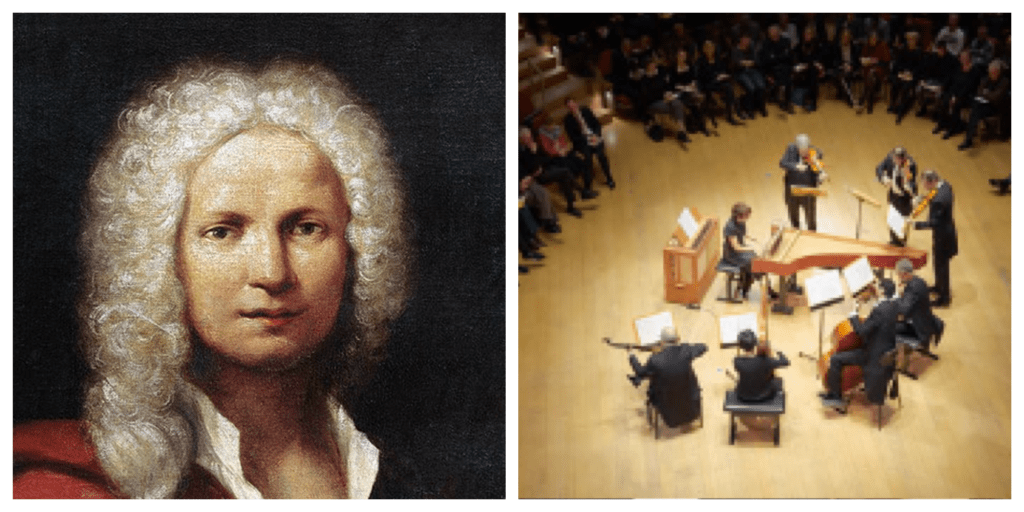
Antonio Vivaldi’s Concerto in D minor RV566, probably dates from the 1720s and features as its solo instruments pairs of recorders, oboes and violins.
He, more than any of his Italian contemporaries, left a great number of works composed for diverse and highly imaginative combinations of wind and string instruments
The earliest known testimony to Vivaldi’s interest in multiple timbres dates back to his Sonata RV779 for violin, oboe, organ and salmoe (a precursor of the clarinet), dating from 1707.
These concerti were at times commissioned for religious or civic festivities Elsewhere, they were intended as gifts to individual music-loving patrons,
In any case, Vivaldi never added wind instruments merely to double or add colour to the strings
His expansion of forces instead signified an augmentation of the entire structure in all directions,
Along with Bach and Handel, Vivaldi ranks amongst the greatest Baroque composers and his influence during his lifetime was widespread across Europe
He pioneered many developments in orchestration, violin technique and programmatic music.
Vivaldi composed many instrumental concertos, for the violin and a variety of other musical instruments, as well as sacred choral works and more than fifty operas.
His best-known work is a series of violin concertos known as The Four Seasons.
Many of his compositions were written for the all-female music ensemble of the Ospedale della Pietà, a home for abandoned children.
Vivaldi began studying for the priesthood at the age of 15 and was ordained at 25, but was given dispensation to no longer say public Masses due to a health problem.
After almost two centuries of decline, Vivaldi’s musical reputation underwent a revival in the early 20th century, with much scholarly research devoted to his work.
Many of Vivaldi’s compositions, once thought lost, have been rediscovered – some as recently as 2015.
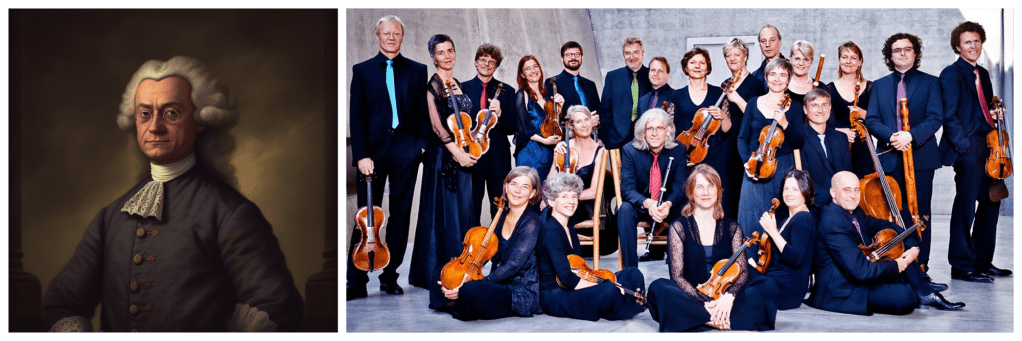
This Ouverture in D is one of Telemann’s very late works and among the last examples of the Baroque suite.
It is dedicated to Count Ludwig VIII of Hessen-Darmstadt, a hunting enthusiast. Appropriately, the score calls for two hunting horns and gives them prominent roles in certain movements.
Bach and Telemann had a significant relationship.
Their connection was quite strong, with Telemann even becoming the godfather to Bach’s son, Carl Philipp Emanuel Bach.
Telemann and Bach first met while Telemann was working in Eisenach and Bach was in nearby Weimar.
They maintained a professional and personal relationship, exchanging musical ideas and respecting each other’s work
Telemann was considered by his contemporaries to be one of the leading German composers of the time, and he was compared favourably both to his friend Johann Sebastian Bach and to George Frideric Handel, whom Telemann also knew personally.
He held important positions in Leipzig, Sorau, Eisenach, and Frankfurt before settling in Hamburg in 1721, where he became musical director of that city’s five main churches.
While Telemann’s career prospered, his personal life was always troubled: his first wife died less than two years after their marriage, and his second wife had extramarital affairs and accumulated a large gambling debt before leaving him.
However, he remained at the forefront of all new musical tendencies, and his music stands as an important link between the late Baroque and early Classical styles.
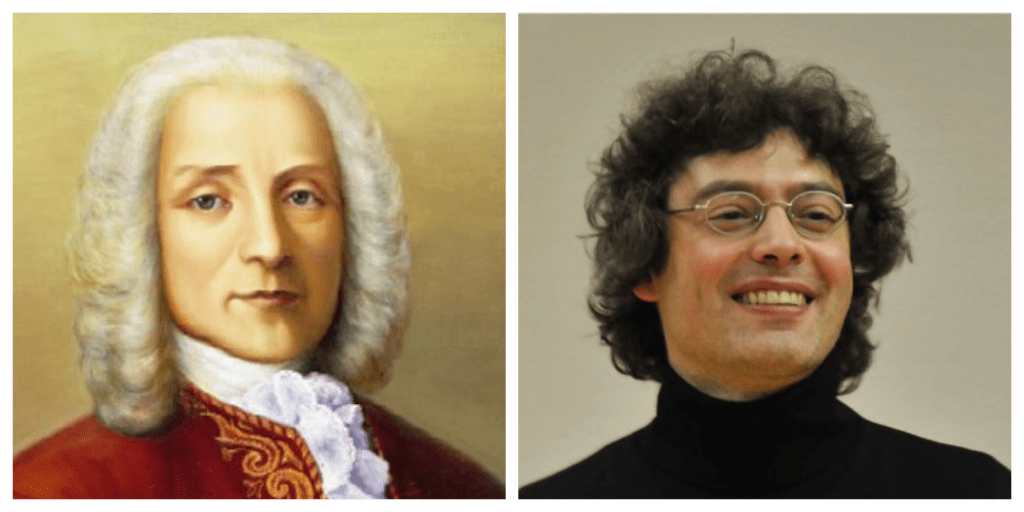
Of Scarlatti’s 555 sonatas, about 10 are for violin and continuo, 3 are specifically for organ, and the rest are for harpsichord.
Scarlatti’s most mature period and largest output was concentrated in the years between 1753, when he was 67, and his death four years later.
Spectacular innovations in keyboard virtuosity—including hand crossing—are often accompanied by dissonances and far-flung modulations.
Scarlatti was an Italian composer and classified primarily as a Baroque composer chronologically, although his music was influential in the development of the Classical (Rococco) style.
Like his renowned father Alessandro Scarlatti, he composed in a variety of musical forms, although today he is known mainly for his 555 keyboard sonatas.
He spent much of his life in the service of the Portuguese and Spanish royal families.
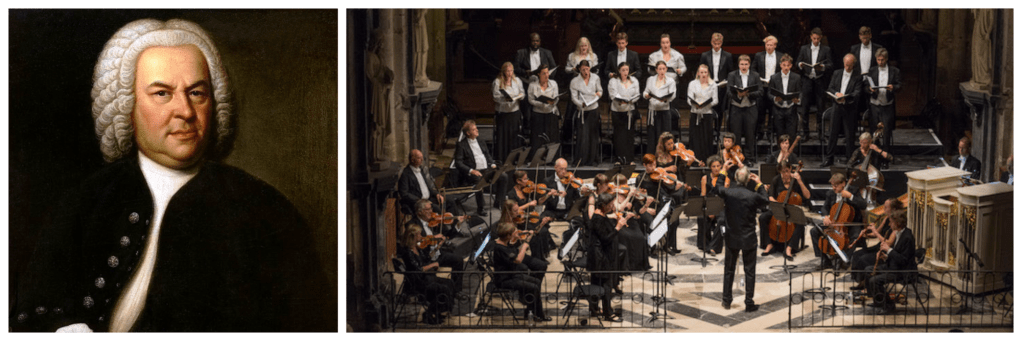
One of the last compositional projects of Bach’s life was to compile the Mass in B minor
The work was never performed in its entirety during Bach’s lifetime
It didn’t receive a full performance until 1859, more than 100 years after his death.
After Bach’s death, his son C.P.E. Bach inherited the score of the Mass and he was particularly drawn to the music of the Symbolum Nicenum, and performed this part of the work on a number of occasions
Performances of parts of the Mass continued throughout the 100 years or so following Bach’s death.
Cum Sancto Spiritu ends Part 1.
Bach’s compositions include hundreds of cantatas, both sacred and secular,Latin church music, Passions, oratorios and motets.
He wrote extensively for organ and for other keyboard instruments and composed concertos and suites, as chamber music as well as for orchestra.
From 1723, Bach was employed as cantor at St Thomas’s in Leipzig where he composed music for the principal Lutheran churches of the city and its university’s student ensemble Collegium Musicum.
In the last decades of his life, he reworked and extended many of his earlier compositions, eventually dying from complications after a botched eye surgery in 1750 at the age of 65.

Leave a comment