
The music of Brazil has developed some unique and original styles such as samba, bossa nova, choro and frevo alongside Brazilian versions of rock, pop, soul, hip-hop, rap and gospel. Instrumental music is also popular in Brazil especially jazz influenced forms. But there is also a long history of classical composers so today’s programme explores some of the composers who influenced and defined its course over the last three hundred years.
Alberto Nepomuceno (1864-1920)
Série brasileira: IV. Batuque (1891)
Minas Gerais Philharmonic Orchestra
Fabio Mechetti (conductor)
José Mauricio Nunes Garcia (1767-1830)
Requiem Mass: IV. Sequence: Dies irae
Helsinki Philharmonic Orchestra
Paul Freeman (conductor)
Camargo Guarnieri (1907-1993)
Flor de Tremembé
São Paulo Symphony Orchestra
Roberto Tibiriçá (conductor)
Heitor Villa Lobos (1887-1959)
Choros No. 1 for guitar (1920)
Carlos Oramas (guitar)
César Guerra-Peixe (1914-1993)
Symphonic Suite No. 2 “Pernambucana”: IV. Frevo
Goiás Philharmonic Orchestra
Neil Thomson (conductor)

Série brasileira is a landmark work in Brazilian music and was written in Berlin when Alberto Nepomuceno was 27 years old.
It is a vivacious suite that employs maxixe rhythms which is a Brazilian tango originating in Rio de Janeiro in 1868.
The last movement, Batuque, includes a reco-reco, a scraper of African origin used as a percussion instrument in Brazilian music.
This novel and colourful inclusion infuriated many of the more traditional music critics of the time.
Alberto Nepomuceno was one of the first Brazilian composers to use elements of Brazilian folk music in his compositions.
He was inspired by other nationalist composers such as Russian School Five and the music of Grieg and even Richard Wagner.
At the age of 24, Nepomuceno began his studies in Europe.
In Berlin he studied composition and piano in Vienna where his classmate was his future wife, the Norwegian pianist Walborg Bang, a student of Edvard Grieg.
Nepomuceno composed 87 songs, 53 of which were in Portuguese (the others in French, Italian, German and Swedish).
Nepomuceno took responsibility for publishing the works of young talents, including Villa-Lobos. At the same time, he dedicated himself to the work of recovering old works, especially those of Father José Maurício Nunes Garcia
Founded in February 21st, 2008, the Minas Gerais Philharmonic Orchestra is based in Belo Horizonte and has become a strong point of cultural reference in Brazil.

José Maurício Nunes Garcia was a Brazilian composer, born in Rio de Janeiro in 1767.
He was the son of Afro-Brazilian parents who were both children of slaves.
His father died while José was still young, but his aunt lived with the family and encouraged him to pursue a musical education with a family acquaintance.
Much of José Maurício’s musical development was against a sacred backdrop, and in 1792 he was ordained as a priest.
A contemporary of Haydn, Beethoven and Mozart, his music largely emulated their ‘Viennese School’ style of Classical composition.
In addition to his 1799 Requiem Mass, he composed large sacred works including a Magnificat, the St. Cecilia Mass and numerous large-scale orchestral works including his ‘Tempest’ Symphony, ‘Funeral Symphony’ (for a Royal visit), and several secular harpsichord and instrumental works.
He wrote the first Brazilian opera – Le Due Gemelle in 1817. Teaching music was a big part of his contribution to Brazilian musical life and he was memorialised on a 1973 Brazilian stamp.

Camargo Guarnieri was a teacher, conductor and composer and one of the dominant figures in Brazilian music in the 20th century.
He wrote in all genres, including two operas, seven symphonies, and six piano concertos, but is best known for his many solo songs and piano pieces.
Even though he remained a devoted nationalist composer throughout his career, Guarnieri also absorbed European elements during his period of studies in Paris.
As a conductor, he appeared with most of the leading European and American orchestras, and continued to play a leading role in orchestral and choral organizations in Brazil until his death.
Flôr de Tremembé (Flower of Tremembé) is a colourful, melodic, and exuberant work for a chamber orchestra of 15 players and percussion.
Although Flôr de Tremembé is influenced by the musical style of Villa-Lobos, Camargo Guarnieri has a completely different personal sound and overall approach to the indigenous musical background.
The writing for bassoon, oboe and horn, creates a musical quality that would be neo-Baroque if it were not for the Brazilian percussion section of rattles and rasps (xocalho and rico-rico) that keep up a typical rhythmic pattern.
The agogó (cowbell) and cuica (the kind of moaning friction drum that energizes a lot of Brazilian music) also make an appearance.
Tremembé is a district of Brazil’s largest city, São Paolo, Guarnieri’s native city which, although heavily populated, it is known for its flowers.
Since its first concert in 1954, the São Paulo Symphony Orchestra has become an integral part of São Paulo and Brazilian culture, promoting cultural and social transformation.
It runs a large educational and outreach program for over 25,000 children and teenagers every season.
It has its own children, youth, and symphonic choirs, as well as a Music Academy, offering professional guidance to young orchestral musicians, singers, and conductor
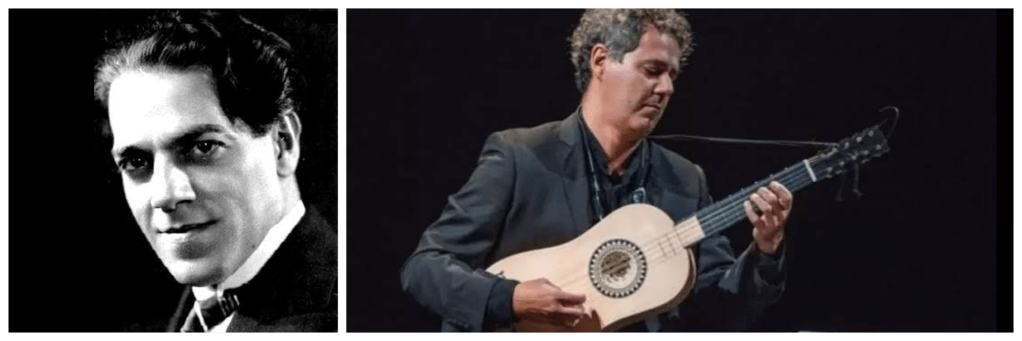
Villa-Lobos’s works are characterized by a blend of Western classical music and Brazilian folk songs and rhythms.
He is one of the foremost Latin American composers of the 20th century.
While traveling with his family around Brazil he developed an interest in native Brazilian folk music.
He played the cello and guitar and toured throughout Brazil absorbing Brazilian folk music and composing his own pieces.
He returned with an intimate knowledge of the Afro-Brazilian music of the country’s northern and northeastern regions alongside his studies of the works of Bach, Richard Wagner, and Giacomo Puccini, whose influence can be noted in his compositions.
Although many critics initially attacked the dissonance and modernity of his work, he persisted in his efforts to merge Western music and the Brazilian vernacular tradition.
He composed ceaselessly (about 2,000 works are credited to him in all), and by the time of his first trip to Europe in 1923 he had produced a long list of compositions in every form, from solo pieces for guitar to trios, quartets, concerti, vocal music, and symphonies.
In 1932 he took charge of music education throughout Brazil and established a conservatory for choral singing in 1942 and, with fellow composer Oscar Lorenzo Fernandez, co-founded the Brazilian Academy of Music in 1945.
Villa-Lobos composed Chôros No. 1 in Rio de Janeiro in 1920
The title is taken from an improvisational genre of Brazilian instrumental popular music that originated in Rio de Janeiro in the nineteenth century.
Four years after composing this work, at the time of his first visit to Paris, he decided to make it part of an extended cycle of works collectively titled Chôros, which eventually included fourteen numbered compositions
It is influenced by the improvised music of the late-nineteenth and early twentieth centuries composers as Zequinha de Abreu, Quincas Laranjeiras, Chiquinha Gonzaga, and Catulo da Paixão Cearense
The simplicity and beauty of the work has made it a favourite with professional guitarists

César Guerra-Peixe was a violinist, teacher, arranger, creator of music for radio, television and film and an ethnomusicologist.
In his early years, he dabbled in serial (twelve-tone) composition, and it served him well in these two colourful symphonic suites.
Both works date from the 1950s, and celebrate the rhythms and percussive sonorities of Brazilian dance music.
Guerra-Peixe’s folk inspirations come out sounding thoroughly modern, more like Bartók, for example, than the early romantic nationalists, and so the result, with its ample use of ostinatos and repetitive gestures, gives the impression of simplicity without ever turning simplistic.
They are fresh and vital and superb example of the energy in contained in Guerra-Peixe’s music.


Leave a comment