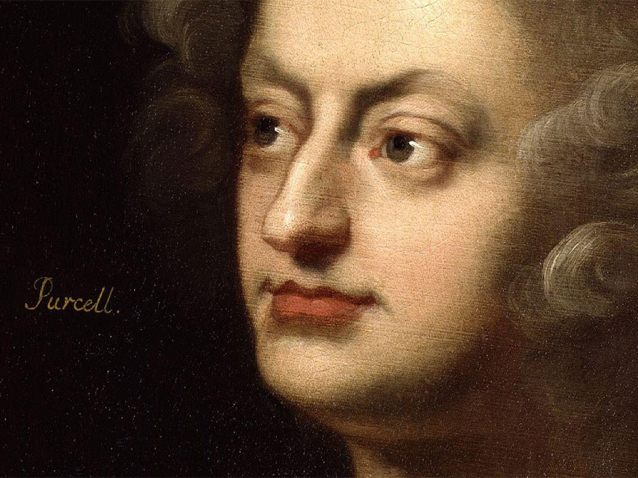
Henry Purcell (1659-1695) was an English composer who is widely regarded as one of the greatest Baroque composers in history. His music was highly innovative, displaying his technical mastery and his ability to convey a range of human emotions through music. Despite facing personal tragedies, professional challenges, and ill health, Purcell persevered and left behind a lasting legacy as one of the most important composers of his time.
I will sing unto the Lord Z22
Choir of Trinity College, Cambridge
Richard Marlow (conductor)
Dido and Aeneas, Z626, Act 3: When I Am Laid in Earth (approx 1688)
Susan Graham (soprano)
Le Concert d’Astreé
Emmanuelle Haïm (conductor)
King Arthur: Act 5 Chaconne Z628 (1691)
Les Arts Florissants
William Christie (conductor)
The Indian Queen: Act III Overture (1695)
The Scholars Baroque Ensemble
Benjamin Britten (1923-1976)
The Young Person’s Guide To The Orchestra, Op. 34
Based on Rondeau from Purcell’s Incidental Music from Abdelazer Z570 (1695) Movement 2

Henry Purcell was an English composer of the middle Baroque period and a contemporary of Johann Sebastian Bach (1685 – 1750), Antonio Vivaldi (1678 – 1741), George Frederick Handel (1685 – 1759), Johann Pachelbel (1653 – 1706), Domenico Scarlatti (1685 – 1757), Tomaso Albinoni (1671 – 1751) and Arcangelo Corelli (1653 – 1713)
He is the most important English composer of his time.
Purcell composed music for the church, the stage, the court, and private entertainment.
respected musical traditions but also learnt from his contemporaries in Europe
Born in St Ann’s Lane, Old Pye Street, Westminster in 1659, along with his brothers: Edward and Daniel, he lived just a few hundred yards west of Westminster Abbey.
Purcell’s father was Master of the Choristers at Westminster Abbey and made sure his son was fully involved in the musical life of Westminster from an early age (Henry was just 15 when his father died).
He was schooled in musicianship, gained vital professional experience and made important friends and eventually admitted as a chorister in the Chapel Royal until his voice broke in 1673
Purcell began composing at nine years old, attended Westminster School and in 1676 was appointed copyist at Westminster Abbey.
As the strictness of the Renaissance gave way to the new expressive freedoms of the Baroque, Purcell thrived and so did music in England.
I will sing unto the Lord is an early anthem written by February 1679.
It was found in a large number of contemporary and early eighteenth-century cathedral manuscripts, suggesting that it was widely performed.

Following the Restoration, Charles II reopened England’s theatres, unleashing commercial stage entertainment that thrived in London in particular.
Theatre folk cajoled Purcell into joining them but Purcell wasn’t persuaded quickly.
But by the time he wrote his first music for the theatre in the 1680s, his dramatic instincts were quite visionary
It would soon lead to his most famous work – if not the first opera in English, then arguably the best-known and most beloved: Dido and Aeneas
It was written to a libretto by Nahum Tate and performed in 1689 in cooperation with Josias Priest, a dancing master and the choreographer for the Dorset Garden Theatre.
Dido and Aeneas is occasionally considered the first genuine English opera, though that title is usually given to Blow’s Venus and Adonis
Dido and Aeneas never found its way to the theatre, though it appears to have been very popular in private circles.
The complete work remained in manuscript until 1840 when it was printed by the Musical Antiquarian Society under the editorship of Sir George Macfarren.

King Arthur, or The British Worthy (Z628), is a semi-opera in five acts with a libretto by John Dryden.
It was first performed at the Queen’s Theatre, Dorset Garden, London, in late late May or early June 169
The plot is based on the battles between King Arthur’s Britons and the Saxons
The tale centres on Arthur’s endeavours to recover his fiancée, the blind Cornish Princess Emmeline, who has been abducted by his arch-enemy, the Saxon King Oswald of Kent.
King Arthur contains some of Purcell’s most lyrical music, using adventurous harmonies for the day.
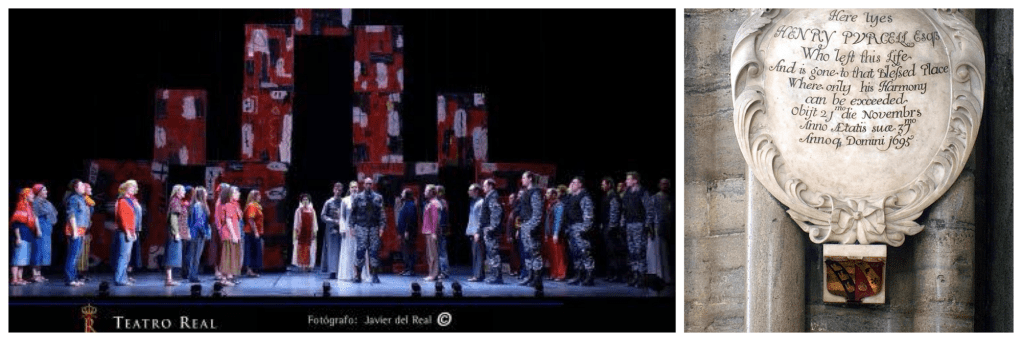
Among the works dating from 1695, the last year of his life, is The Indian Queen, which was still incomplete at the time of his death.
The music consists of overtures, dances and various vocal interludes for a play by John Dryden and Robert Howard.
The story of The Indian Queen deals with wars between the Incas of Peru and the Aztecs of Mexico (two groups that never would have met, except in a theatre).
The music to The Indian Queen has been called some of Purcell’s finest work but sadly it is rarely performed as the work is incomplete.
Purcell died on 21 November 1695 at his home in Marsham Street at the height of his career and is believed to have been 35 or 36 years old at the time.
The cause of his death is unclear: one theory is that he caught a chill after returning home late from the theatre one night to find that his wife had locked him out.
Another is that he succumbed to tuberculosis
He is buried adjacent to the organ in Westminster Abbey and music that he had earlier composed for Queen Mary’s funeral was performed during his funeral.
Following his death, the officials at Westminster honoured him by unanimously voting that he be buried with no expense spared in the north aisle of the Abbey.
Purcell and his wife Frances had six children, four of whom died in infancy.

Purcell also had a strong influence on English composers of the English of the early 20th century, most notably Benjamin Britten, who arranged many of Purcell’s vocal works for voice(s) and piano in Britten’s Purcell Realizations.
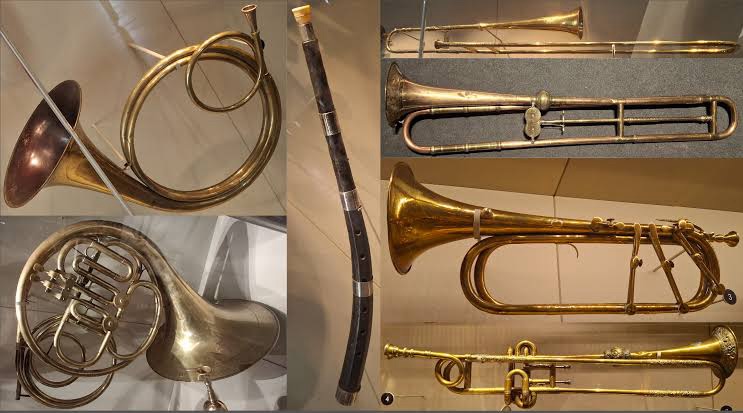
The Young Person’s Guide to the Orchestra, Op. 34, is a 1945 composition by Benjamin Britten with a subtitle Variations and Fugue on a Theme of Purcell. It was based on the second movement, Rondeau, of the Abdelazer suite. It was originally commissioned for the British educational documentary film called Instruments of the Orchestra released on 29 November 1946, directed by Muir Mathieson and featuring the London Symphony Orchestra conducted by Malcolm Sargent
Purcell’s Music still has relevance today in popular culture: the Funeral Music of Queen Mary was reworked by Wendy Carlos for the title music of the 1971 film by Stanley Kubrick, A Clockwork Orange.
In 2009 Pete Townshend of The Who identified Purcell’s harmonies as an influence on the band’s music
In 2013, the Pet Shop Boys released their single Love Is a Bourgeois Construct incorporating one of the same ground basses from King Arthur used by Michael Nyman in his The Draughtsman’s Contract score.
Purcell’s music has been featured in films such Kramer vs. Kramer, the German-language 2004 movie, Downfall, in which the music of Dido’s Lament is used repeatedly as Nazi Germany collapses.

Leave a comment