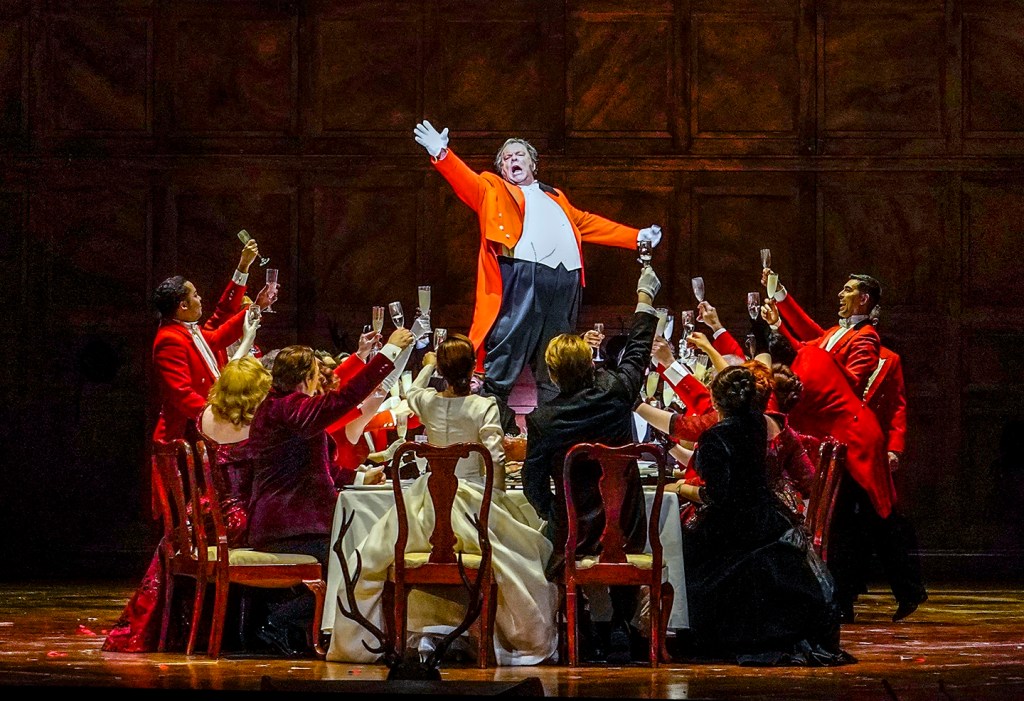
Arias come in different shapes and sizes but in essence they are ‘songs’ in an opera and are used by the composer to communicate what characters are thinking and feeling. They are usually a self-contained piece for solo voice with orchestra and, In opera, they mostly appear during a pause in the dramatic action when a character is reflecting on their emotions. Most arias are lyrical and are not unique to opera, as they also appear in oratorios, cantatas, and other vocal genres. In Conversation focuses on some of the well known and best lived arias in the operatic repertoire.
Wolfgang Amadeus Mozart (1756-1791)
The Magic Flute: Act 2 Queen of the Night
Sumi Jo (soprano)
Paris Chamber Orchestra
Armin Jordan (conductor)
Gioccomo Rossini (1792-1868)
The Barber of Seville: Largo al factotum
Alan Opie (baritone)
London Symphony Orchestra
Charles Bizet (1838-1875)
Carmen: Act 1 Habanera
Marilyn Horne (mezzo soprano)
Metropolitan Opera Orchestra
Leonard Bernstein (conductor)
Modest Mussorgsky (1839-1881)
Boris Godunov: Vaarlam’s Song Once Upon a Time in the Town of Kazan
Boris Christoff (bass)
French Radio Orchestra
Issay Dobrowen (conductor)
Giuseppe Verdi (1813-1901)
Rigoletto: Act 3 La Donna e mobile
Jonas Kaufman (tenor)
Palma Opera Orchestra
Pier Giorgio Morandi (conductor)

Mozart’s The Magic Flute was one of his great triumphs. It is a comic opera, light hearted in its story and spectacular with its jaunty and witty music. At the same time, it is full of serious and political messages. The story is a mixture of fun and high ideals, of Masonic philosophy and high jinx, of brotherhood and love affairs, of melodrama and rational philosophy. Mozart was in dire need of money, was in bad health and his wife was very sick. He needed a hit, and to that commercial end, collaborated with the prominent writer, actor, producer, and personal friend (Schikaneder) to provide a suitable libretto. It was completed in 1789 and during its first ten years, The Magic Flute was presented 233 times in the original theatre and radiated out over Europe.
Mozart joined the Freemasons on January 7 1785 and the reference to the number three appears constantly throughout the opera: in the opening key of E flat major (three flats) the Three Ladies (attendants to the Queen) the Three Spirits, the tri-partite dissection of the serpent, three couples dominate the plot, three boys announce the three ordeals the lovers Tamino and Pamina must endure before they unite. Plus there are three temples: Wisdom, Reason, and Nature so the connection to Freemason philosophy is unmistakable.
The Queen of the Night is Pamina’s mother and Act II she sings Der Hölle Rache (The Revenge from Hell) when she discovers that her daughter has converted to her kidnapper’s philosophy and she swears retribution. At this time, she gives her terrified daughter a dagger and insists that she kill her rival, Sarastro. If Pamina does not kill him, she is subject to possible death and certainly to being disowned and cursed. This aria demands every ounce of control, endurance, and skill from a soprano coloratura as its vocal range spans more than two octaves. Like the Overture, this aria is often separated from the full opera as a stand-alone performance.
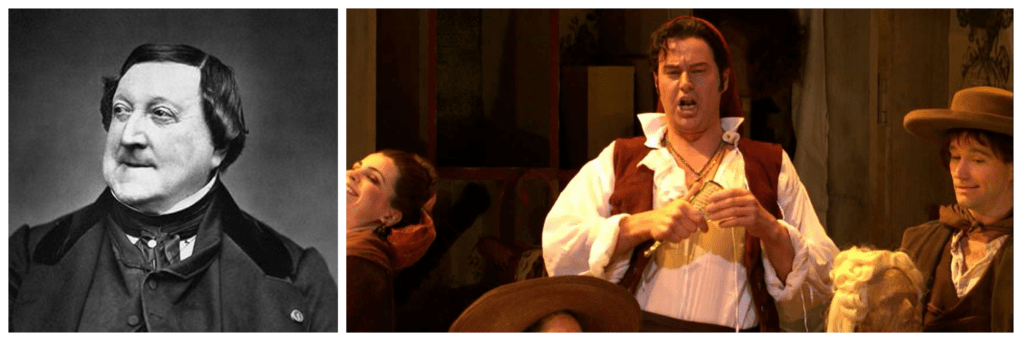
Rossini was an Italian composer who gained fame for his 39 operas, although he also wrote many songs, some chamber music and piano pieces and some sacred music. He set new standards for both comic and serious opera before retiring from large-scale composition while still in his thirties, at the height of his popularity.
Born in Pesaro to parents who were both musicians, Rossini began to compose by the age of twelve and was educated at music school in Bologna. His first opera was performed in Venice in 1810 when he was 18 years old. In 1815 he was engaged to write operas and manage theatres in Naples. In the period 1810–1823, he wrote 34 operas for the Italian stage that were performed in Venice, Milan, Ferrara, Naples and elsewhere; this productivity necessitated an almost formulaic approach for some components (such as overtures) and a certain amount of self-borrowing. During this period he produced his most popular works, including the comic operas L’italiana in Algeri, Il barbiere di Siviglia and La Cenerentola, which brought to a peak the opera buffa tradition he inherited from masters such as Domenico Cimarosa and Giovanni Paisiello. Rossini’s withdrawal from opera for the last 40 years of his life has never been fully explained; contributory factors may have been ill-health, the wealth his success had brought him, and the rise of spectacular grand opera under composers such as Giacomo Meyerbeer.
A wily barber called Figaro is the title character in two great operas, Mozart’s The Marriage of Figaro and Rossini’s The Barber of Seville. Both composers found the character in plays by Beaumarchais, and Rossini’s opera tells the first part of Figaro’s story. Figaro introduces himself with Largo al factotum, a number that’s often called, simply, ‘The Figaro Aria.’ It’s a boastful and buoyant aria in which Figaro explains exactly why he’s the most famous barber in Seville, and it gives the singer a chance to show off his fast-talking, ‘patter’ technique. Because of the constant singing of eighth notes at an allegro vivace tempo, the piece is often noted as one of the most difficult baritone arias to perform. This, along with the tongue-twisting nature of some of the lines, insisting on Italian superlatives (always ending in –issimo), have made it a pièce de résistance in which a skilled baritone has the chance to highlight all of his qualities. For this reason, a few dramatic tenors have also sung the aria, notably Mario Del Monaco and Plácido Domingo

Georges Bizet was yet another of those composers who showed precocious brilliance as a child but never lived long enough to fulfill the promise. The difference, however, between Bizet and Mozart, who died at about the same age, is that Mozart left over 600 completed compositions, many of them masterpieces, while Bizet is known primarily for a single work, the opera Carmen. In Addition, only a few other works – the opera The Pearl Fishers, the symphony in C and a couple of suites from his incidental music to the now forgotten play L’arlesienne – are still occasionally heard today.
Carmen, based on a contemporary novella by Prosper Merimée, is the story of a fickle seductress who ensnares Don José, an innocent young soldier, into a passion that leads inexorably to desertion, degradation and finally a jealous murder on stage. Audiences and critics alike considered Carmen scandalous and immoral (although that didn’t stop it from enjoying the longest run of any of Bizet’s previous works). But when the critics panned it Bizet was crushed and succumbed to a chronic throat ailment from which he never recovered. Within three months of the premiere, he was dead.
Carmen’s fame rose gradually and it is now in the permanent repertory of virtually every opera company. Carmen sings the Habanera in Act I. As the cigarette factory bell rings and the workers amble out, the soldiers are waiting for Carmen. After a dramatic solo entrance she launches into the aria. As she sings and dances, she sidles up to Don José, the one soldier who is obviously ignoring her, throws a red cassia flower at his feet and dashes back into the factory.
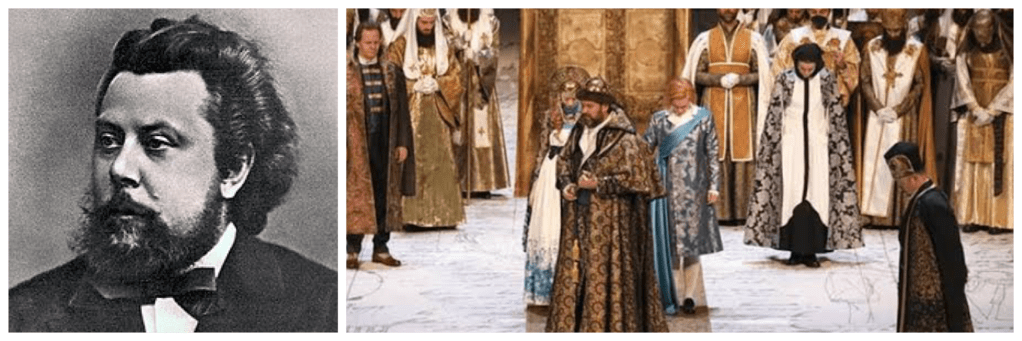
Modest Petrovich Mussorgsky was one of five Russian composers known as the ‘Mighty Handful’ for their nationalist tendencies. Everything he composed was conceived in terms of natural rhythms, melodies and harmonies of Slavonic folk music. He constantly railed against tradition, honing his music in order to make it, in his words, ’an artistic reproduction of human speech in all its finest shades.’ Mussorgsky’s natural talent was obvious from the start. Initially taught by his mother he became a pianist prodigy, making his debut at nine years old. Four years later, in 1852, he enrolled at the Imperial Guard’s cadet school and composed the Porte-en-seigne polka, a surprisingly cheery piano miniature.
In 1863, a shortage of funds forced Mussorgsky to take a job as a clerk in the civil service. Though brimful of startlingly original ideas, the pieces he composed in his spare time often lacked any musical logic and he abandoned many works out of sheer frustration. Indeed, if it hadn’t been for Rimsky-Korsakov’s later kindness and support, Mussorgsky, and his music, might have fallen by the wayside.Throughout the 1870s, Mussorgsky became increasingly prone to epileptic seizures, and his predilection for alcohol quickly developed into full-blown dependency. Boris Godunov (1552– 1605) was the de facto regent of Russia from 1585 to 1598 and then tsar from 1598 to 1605 following the death of Feodor I, the last of the Rurik dynasty.
After Mussorgsky’s death in 1881, his fellow‐composer Nikolai Rimsky‐Korsakov overhauled Boris Godunov, which was not incomplete but which Rimsky thought needed tidying up, ‘correcting’ and reorchestrating. His second version, the one that made the opera popular, was first performed in Paris in 1908.Two vagabond monks, Missail and Varlaam, arrive with Grigory, who has escaped from the monastery. Varlaam embarks on a boisterous song about Ivan the Terrible’s victory over the Tartars at Kazan.

Giuseppe Verdi is one of the greatest opera composers, and arguably the most popular of all. His name is synonymous with the history of Italian music in the second half of the 19th century, his work is central to the repertory of every opera house in the world. He is sometimes compared with Shakespeare, whom he adored, though he spoke little English and knew the Bard’s work only in translation. Verdi was an outstanding melodist, and some of his arias and choruses – such as La Donna è Mobile from Rigoletto, La Traviata’s Brindisi (the drinking song) and the Anvil Chorus from Il Trovatore – are familiar to millions. In Italy, the Chorus of Hebrew Slaves from Nabucco has long been associated with national unity and solidarity. The Grand March from Aida, meanwhile, has become a staple of the brass band repertory and is sometimes used at weddings, and Verdi’s music can be heard on the soundtracks of films from Zack Snyder’s 300, Claude Berri’s Manon des Sources to Luchino Visconti’s Senso, it has advertised lager, jeans and pasta sauce. It even features in the video game Grand Theft Auto.
La donna è mobile (Woman is fickle) is the Duke of Mantua’s aria from the beginning of Act 3 of Verdi’s opera Rigoletto (1851). The aria is famous as a showcase for tenors and Raffaele Mirate’s performance of the bravura aria at the opera’s 1851 premiere was hailed as the highlight of the evening. Before the opera’s first public performance (in Venice), the aria was rehearsed under tight secrecy, a necessary precaution, as La donna è mobile proved to be incredibly catchy and soon after the aria’s first public performance, it became popular to sing among Venetian gondoliers. As the opera progresses, the reprise of the tune in the following scenes contributes to Rigoletto’s confusion as he realizes from the sound of the Duke’s lively voice coming from the tavern (offstage) that the body in the sack over which he had grimly triumphed was not that of the Duke after all; Rigoletto had paid Sparafucile, an assassin, to kill the Duke, but Sparafucile had deceived Rigoletto by indiscriminately killing Gilda, Rigoletto’s beloved daughter, instead.

Leave a comment