
Maurice Ravel was a French composer well known for his innovative piano pieces and brilliant orchestral works such as Boléro and Daphnis et Chloé. Sometimes referred to as an ‘impressionist’ composer his complex orchestrations were precise and unique. Ravel influenced both contemporary and younger composers such Ralph Vaughan Williams (1872-1958), Manuel de Falla (1876-1946), John Ireland (1879-1962) and Arnold Bax (1883-1953). Although considered as one of the great 20th Century composers he self-deprecatingly said ‘I am not one of the great composers…I have written relatively very little…and at that, I did it with a great deal of difficulty. I did my work slowly, drop by drop.’
Le Parade (1896)
Francois-Joël Thiollier (piano)
Daphnis and Chloé Suite No 1: War Dance (1911)
Royal Concertgebouw Orchestra
Bernhard Haitink (conductor)
Le Tombeau de Couperin: IV Rigaudon (1919)
Suisse Romande Orchestra
Ernest Ansermet (conductor)
Piano Concerto in G Op 83 III Scherzo (1929-1931)
Martha Argerich (piano)
Berlin Philharmonic Orchestra
Claudio Abbado (conductor)
Boléro (1928)
Dallas Symphony Orchestra
Charles Munch (conductor)
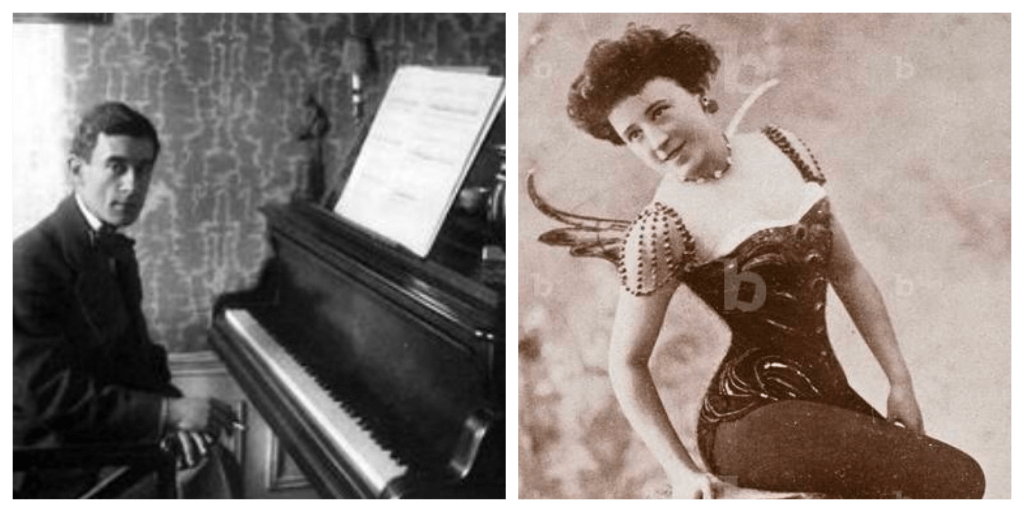
La Parade is a piano work by Maurice Ravel, undated and under the pseudonym of Jack Dream or Jacques Dream. Composed for the dancer Antonine Meunier who created it in Palais des Beaux-Arts in Monte-Carlo on March 5 , 1902. The score for this Ballet sketch for piano was published posthumously in 2008 by Éditions Durand-Salabert-Eschig , based on the autograph manuscript kept at the Bibliothèque nationale de France , to which it was donated in 1972, the year of Antonine Meunier ‘s death. In 1994, when the score was still unpublished, François-Joël Thiollier was the first to record La Parade in his complete works for solo piano by Ravel for the Naxos label .

When Serge Diaghilev asked Maurice Ravel to write a ballet for Diaghilev’s Ballets Russes in 1909, Ravel had no idea what creative frustrations awaited him. Ravel was no stranger to ballet music – a substantial number of Ravel’s compositions were written for or later transformed into ballets – but in this instance, it was Diaghilev and his choreographer Michel Fokine, not Ravel, who chose the subject: the ancient Greek tale of Daphnis and Chloé. After a financially disastrous 1908 season, Diaghilev sought to boost attendance by commissioning music from French composers. For his part, Ravel viewed Diaghilev’s request as a great opportunity to boost his compositional bona fides. Trouble began when Ravel found himself in an artistic standoff with choreographer Michel Fokine. The two men had entirely different and incompatible ideas about how to interpret the story, which led to a number of arguments. Ravel sketched out a one-act ballet in three scenes, or tableaux, which he described as a choreographic symphony in three parts. For his part, Diaghilev had such grave doubts about the “symphonic” nature of the score, fearing it unsuitable for ballet, that he considered scrapping the whole project; he thought the music heavy on atmosphere at the expense of action. Ravel’s belated completion of the score meant the dancers did not get enough rehearsals before the premiere. Even with sufficient time, Ravel’s music still presented formidable challenges: the dancers had difficulty with Ravel’s use of unconventional time signatures (7/4 and 5/4), as well as his penchant for off-beat accents and abrupt tempo changes. Add the fact that Diaghilev cut the original four scheduled performances to two for the premiere in June 1912, it is no surprise that Daphnis and Chloé attained only moderate success as a ballet.

World War I inspired many works of music and Maurice Ravel took inspiration from his many friends who died during the war to create a piano work, Le Tombeau de Couperin (1914-1917). The structure of the work, as referred to in the title’s reference to Couperin, is that of a Baroque dance suite. He wasn’t particularly paying homage to Couperin but it did give Ravel an opportunity to dedicate each movement to an close friends who had died during the war. These friends were not only fellow musicians but also childhood friends, musicologists, and painters. The Rigaudon is dedicated to Pierre and Pascal Gaudin, two childhood friends of Ravel, who were killed by the same shell on 12 November 1914, the first day they arrived at the front. It was Ravel’s piano teacher, Marguerite Long, who pointed out that ‘Le Tombeau contains no laments or funeral-march rhythms, and that its joyful character evokes the love of life felt by all these men who died so young.’ The work was given its premiere by Marguerite Long at the Salle Gaveau in Paris on 11 April 1919. In 1919, Ravel transcribed four of the six movements for orchestra and this version was given its premiere in Paris on 28 February 1920.

Ravel had long toyed with the idea of composing a work for piano and orchestra, but he would not complete his two piano concertos (one for the left hand alone and this one for both hands) until he was in his mid-fifties. A triumphant tour of the United States in 1928 had solidified his reputation as one of the world’s greatest living composers, and he began work on his Piano Concerto in G the following year. He planned to play it himself on an even grander world tour that would include not only Europe and the United States, but also South America and East Asia. In place of heavy, emotionally intense music associated with piano concertos written by Romantic composers, Ravel wrote music with a lightness of touch that delights the mind and senses. The concerto famously opens with the crack of a musical whip and Ravel chooses to omit a more lengthy traditional development in his pursuit of a more lighthearted and brilliant concerto. The finale matches the effervescent humour of the first movement with two deas playing important roles: a march-like melody based on three descending notes and brassy fanfares. Though Ravel diligently practiced profusely to prepare himself to play his concerto, ill-heath prevented him from performing the piece.
Instead, his friend the pianist Marguerite Long played the solo part and Ravel conducted the orchestra at the premiere in Paris in 1932. Sadly, this would be one of Ravel’s final completed works. He stopped composing after 1932, afflicted with a neurological disease that made it difficult for him to write, speak and coordinate his movements.

Ravel’s most famous piece today is undoubtedly Boléro, originally a one-act ballet, commissioned by the dancer Ida Rubinstein and premiered in Paris in 1928. The work is named after the dynamic 3/4 time Spanish dance although Boléro is usually performed a little slower. The music is highly unusual in that it repeats almost all the way through the piece, a theme in C major. The theme drives the piece forward through 300 bars, never changing rhythm but eventually rising to a crashing finale. The first choreography of Boléro was by Nijinskaya, with subsequent runs choreographed by Lifar in 1941 and Béjart in 1961. Boléro was certainly something new and was used in a major 1934 Hollywood film, also titled Bolero, starring Carol Lombard and George Raft who play a pair of dancers. Ravel’s Boléro was used at the Winter Olympics in Sarajevo in 1984 by the British skaters Jayne Torvill and Christopher Dean who skated to the music and won the gold medal with perfect 6.0 scores from all judges, a first in the sport.

Leave a comment