
Igor Stravinsky’s Neoclassical period (roughly from the 1920s to the mid-1950s) marked a return to classical forms and styles, influenced by the music of composers like Johann Sebastian Bach, Wolfgang Amadeus Mozart and Beethoven, but still encapsulating Stravinsky’s unique style. This period emerged after the completion of his ballets, The Firebird, Petrushka, and The Rite of Spring, which were rooted in Russian folk themes and sumptuous orchestration. Stravinsky often drew from Baroque music, particularly counterpoint and fugue incorporating Classical-era features such as symphonic structure and leaner instrumentation. His Neoclassical works emphasize clarity, order, and structure and focus on discipline and restraint rather than emotional expression or complex rhythms.
The Soldier’s Tale (Concert Suite): IV. The Royal March
Royal Scottish National Orchestra
Neeme Järvi (conductor)
Pulcinella Suite: IX. Finale
Tapiola Sinfonietta
Masaaki Suzuki (conductor)
Concerto For Piano And Wind Instruments: 3. Allegro
Olli Mustonen (piano)
Deutsche Symphony Orchestra Berlin
Vladimir Ashkenazy (conductor)
Apollon Musagète Tableau II: Coda. Vivo – Tempo sostenuto – Agitato
USSR State Radio and Television Symphony Orchestra
Gennady Rozhdestvensky (conductor)
Stravinsky: The Rake’s Progress, Epilogue: “Good People, Just a Moment” (Anne, Baba, Tom, Nick, Trulove)
Lyon Opera House and soloists
Kent Nagano (conductor)

Stravinsky’s move to Neoclassicism was, in part, a response to the cultural shifts and aftershocks of World War I. The conflict left many artists, including Stravinsky, seeking order and clarity in a world that had been turned upside down. Additionally, Stravinsky’s desire to escape the heavy emotionalism of late Romanticism, which had dominated European music during the 19th century, led him to explore a more intellectual and objective style. The Soldier’s Tale, a theatrical work for narrator, dance, and a small ensemble, demonstrates Stravinsky’s shift toward smaller, more intimate forces. While its style is neoclassical in its ight, transparent texture, it also displays elements of jazz and folk music, making it one of Stravinsky’s most eclectic works. Toward the end of World War I, Stravinsky was facing the harsh realities of economic deprivation: payments from his German publishers were being held back, and the Russian Revolution had cut off his income from the family estate. Out of necessity came the chamber-sized neo-classic orchestra. The score of The Soldier’s Tale emerged as a marvel of economy and ingenuity, foregoing the large ballet orchestra of The Firebird, Petrushka, and The Rite of Spring. The music has a raw, biting edge that dispels any vestiges of Romanticism and is propelled by obsessive ostinatos and dissonances, abrasively contradicting the mostly diatonic harmonic structure. The first performance of The Soldier’s Tale took place on September 28, 1918 in Lausanne, Switzerland. The performance featured a narrator, a soldier, the devil, and a princess, and it combined music, narration, and dance in an experimental form that was very innovative for its time.

The Neoclassical style also aligned with broader artistic trends of the early 20th century, particularly in literature and visual arts, where artists sought to re-establish connections with classical antiquity or re-imagine it in modern terms. Stravinsky’s Neoclassical works helped redefine the role of classical music in the modern era. His return to classical forms was innovative rather than reactionary, making him one of the central figures in the evolution of 20th-century music. He inspired later generations of composers, who would also explore the tension between tradition and modernity. Pulcinella, a ballet score based on themes by Giovanni Pergolesi, is one of the cornerstone works of Stravinsky’s Neoclassical style. It blends the 18th-century style with Stravinsky’s own harmonic language and rhythmic innovation. It’s a prime example of his reinterpretation of older styles through a modern lens. Stravinsky wrote at least 12 scores specifically for ballet production and prime mover was Serge Diaghilev, the Russian impresario for whom the composer wrote his early (1910-13) ballets, The Firebird, Petrushka, and The Rite of Spring. He struck upon the music of Pergolesi as a likely prospect for Stravinsky’s manipulation. Stravinsky chose various pieces attributed to Pergolesi, and from an old manuscript he took a comic episode whose leading character was Pulcinella, the traditional hero of Neapolitan commedia dell’arte. Maintaining most of the original melodies and basses, Stravinsky reinvents the music with added notes and ostinatos, providing additional harmonic and rhythmic interest. The ballet was introduced in Paris on May 15, 1920, with choreography by Léonide Massine – who also danced the title role – and sets and costumes by Pablo Picasso. The concert suite, consisting of 11 movements of the ballet’s 18, was made in 1922.

The first performance of Stravinsky’s Concerto pour Piano avec L’Orchestre d’Harmonie occurred in Paris in May 1924, only one month after the completion of the score, with the composer as soloist and Serge Koussevitsky conducting. Stravinsky uses the term ‘Harmonic Orchestra’ as the work consists solely of winds and percussion but does include double basses. It is one of the composer’s most unique and innovative works. Stravinsky was commissioned by the French pianist Arthur Rubinstein who, ultimately, declined to perform it so the first performance was given by the French pianist and composer Nikita Magaloff. The wind ensemble accompaniment gives the piece a distinctive sound, with an emphasis on clarity, lightness, and transparency. The concerto follows the three movement classical structure: Toccata: a lively and rhythmical movement, Andante: more lyrical and subdued, providing a contrast to the energetic opening movement and Finale:playful and rhythmic, with strong, syncopated motifs.

Early in April 1927 Stravinsky received a commission from the Coolidge Foundation at the Library of Congress to compose a work for a festival of new music to be held at the library the following April. The piece was to be a small ballet, with not more than a half-dozen dancers, on a subject of his own choosing, which would last about half an hour. The premiere of Apollon Musagète was to be held in a hall which was not equipped with theatre wings which meant scenery had to be specially adapted and technically as simple as possible. His theme was Apollo, the leader of the Muses and the limitation on the number of dancers forced a reduction from the traditional nine Muses to the three most closely associated with the dance: Calliope, Polyhymnia, and Terpsichore. With Apollo himself and two unnamed goddesses, they made up the maximum of six dancers allowed for the performance with a score deliberately limited to strings alone. The work is conceived melodically almost throughout, and the writing is mostly diatonic which rather astonished the first listeners, who knew Stravinsky most recently as the composer of Oedipus Rex and the Concerto for Piano and Winds. Prokofiev wrote to Miaskovsky: ‘I am disappointed in Apollo. The material is poor, taken from all the miserable pockets of Gounod, Delibes, Wagner, and even Minkus. All of this is presented adroitly and skillfully…. Stravinsky missed the most important thing, and the work’s a terrible bore‘. The choreography by George Balanchine was groundbreaking, as it marked a departure from the more theatrical, narrative-driven ballet traditions of the past and introduced a more abstract style with minimal sets and costumes. The simplicity of the staging and the focus on pure movement were revolutionary and became a hallmark of Balanchine’s later choreographic work.
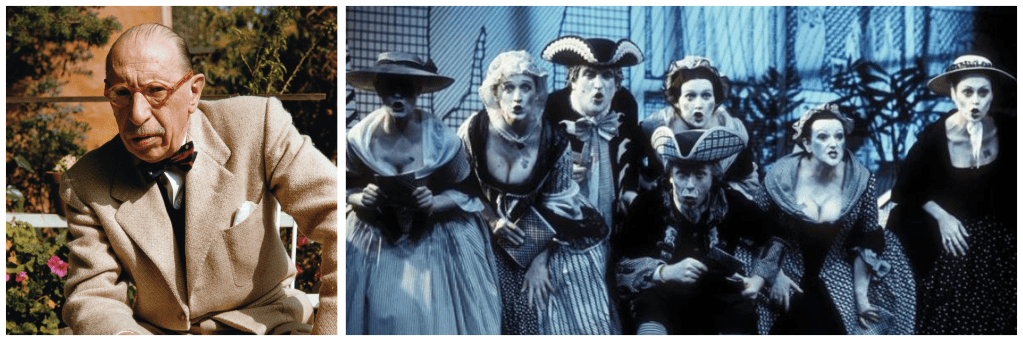
The Rake’s Progress is Stravinsky’s largest work, his only full-length work for the theatre and his first major work in English. It also represents the culmination of his neoclassical years. The idea was prompted by seeing an exhibition in Chicago in 1947 of a series of Hogarth prints and he instantly recognized their operatic potential. The depiction of the ironic progress of the spendthrift heir of a miser from wealth via debt to madness and death is, in essence, retained in the opera. Stravinsky’s Hollywood neighbour Aldous Huxley suggested he contact the English poet W.H. Auden, resident in New York, to write the scenario and libretto, which Auden did with the assistance of his lover and opera buff Chester Kalmann. The inventive libretto is brilliantly matched by Stravinsky’s music, which takes as its source the whole of operatic history from Monteverdi to Verdi via Rossini and Donizetti and large doses of Mozart. The Rake’s Progress can be appreciated on many levels, which might explain why it is still one of only a handful of 20th-century operas never to have been out of the repertoire.


Leave a comment