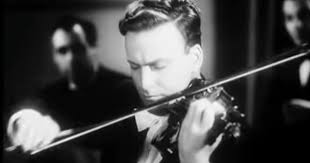
The most musically gifted violin prodigy of his generation, Yehudi Menuhin was one of the defining figures in 20th-century culture. With a legacy of iconic recordings, improvising with Stéphane Grappelli, performing ragas with Ravi Shanker and conducting the world’s great orchestras, he devoted his life to breaking down musical barriers.
Edward Elgar (1857-1934)
Violin concerto Movt 1 (recorded 1932)
Yehudi Menuhin (violin)
London Symphony Orchestra
Sir Edward Elgar (conductor)
Ludwig van Beethoven (1770-1827)
Violin Concerto in D Movt III ( recorded 1966)
Yehudi Menuhin (violin)
Philharmonia Orchestra
Wilhelm Fürtwangler (conductor)
Raga Piloo (recorded 1968)
Yehudi Menuhin (violin)
Ravi Shankar (sitar)
Jacob Gade (1879-1963) arranged Max Harris
Jealousy (recorded 1974)
Yehudi Menuhin (violin)
Stephane Grappelli (violin)
The Alan Clare Trio
Peter Tchaikovsky (1840-1893)
Violin Concerto in D (recorded 1959)
Yehudi Menuhin (violin)
Royal Philharmonic Orchestra
Sir Adrian Boult (conductor)

Menuhin’s first teachers were Sigmund Anker and Louis Persinger. He turned down the opportunity of violin lessons with Eugene Ysaÿe (Persinger’s teacher) but, in 1927, he began lessons with his hero George Enescu, with whom he struck up an instant rapport despite an age gap of 35 years. His first public concert début was in 1924 aged seven and in 1925 he gave his first full length recital in San Francisco. His New York recital début at the Manhattan Opera House and his first concerto performance with the San Francisco Orchestra (age 10) took place in 1926. At the age of 11, he performed his first concerto concert in Carnegie Hall with the New York Symphony Orchestra under Fritz Busch. A gift of the Stradivarius violin ‘Prince Khevenhüller’ by Henry Goldman followed in 1929 along with his Berlin Philharmonic Orchestra debut aged 13. So by the time the 15 year-old Yehudi Menuhin stepped into the newly-opened Abbey Road studios to make his first concerto recording in November 1931, he was already a celebrated international phenomenon – a violin prodigy whose performances had amazed musicians and audiences alike, not merely by his technical abilities, but also by the emotional depth and maturity he was able to convey.The producer Fred Gaisberg hit upon an idea of pairing him with Elgar for a recording of the latter’s violin concerto after having tried unsuccessfully for years to get Fritz Kreisler to record the concerto he had premièred with the composer in 1910. With the Elgar’s advancing age and a feeling that time was running out, he passed the score on to Menuhin who quickly fell in love with the work. Menuhin travelled to London in July 1932 to rehearse and record it with the composer. Elgar was so pleased with Menuhin’s interpretation he cut the rehearsal short to go off to the races. The recording which followed has attained a legendary status is rarely out of the catalogue.
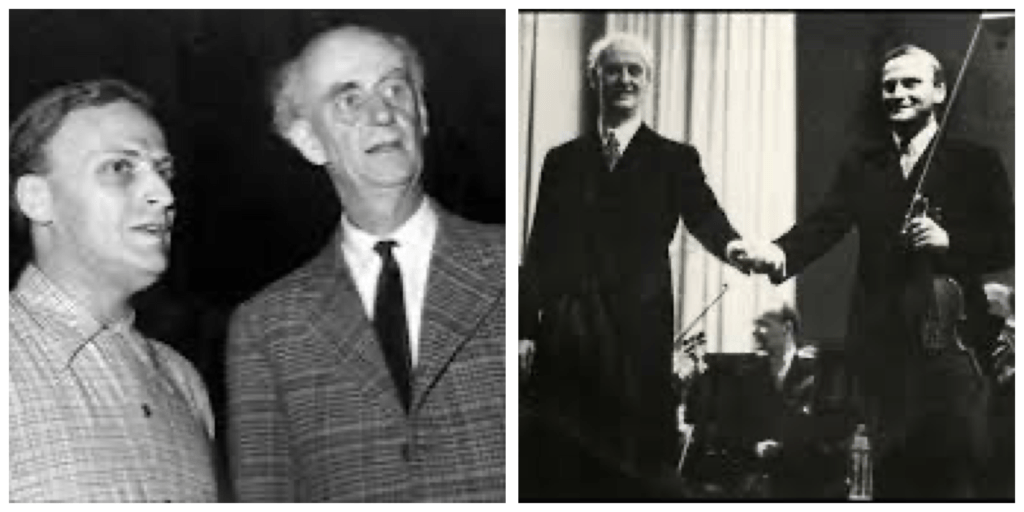
More engagements followed including a world tour in 1935, visiting Australia, New Zealand, South Africa and Europe where the teenager gave 110 concerts in 72 cities. After an 18 month sabbatical Menhuin gave the US première of Violin Concerto by Schumann aged 21. When the US entered the Second World War in 1942 he performed for troops and made his first wartime visit to Britain. His other wartime performances included a tour of military bases in Alaska and Aleutian and concerts for the Pacific Ocean battle troops in Hawaii. In 1945 Menuhin performs for inaugural United Nations assembly in San Francisco and, along with Benjamin Britten on piano, plays for survivors of concentration camps at Belsen. In total, Menuhin performed over 500 concerts for Allied troops during the Second World War. Between 1945 and 1981Yehudi Menuhin recorded the Beethoven Violin Concerto 10 times, a remarkable achievement. As a Jew and a classical musician, Menuhin had a complex relationship with German culture. He was fluent in German and deeply influenced by classical German composers. Menuhin found in the German conductor Wilhelm Furtwängler an important musical peer. Despite accusations of Furtwängler’s pro-Nazi sympathies, Menuhin continued to support him and his work. It seemed that for many years, Menuhin led a double life. He was an outspoken supporter of dozens of causes for social justice, while also longing for a solitary life where he could ignore the concerns of society and attend only to the history of music and his role within it.
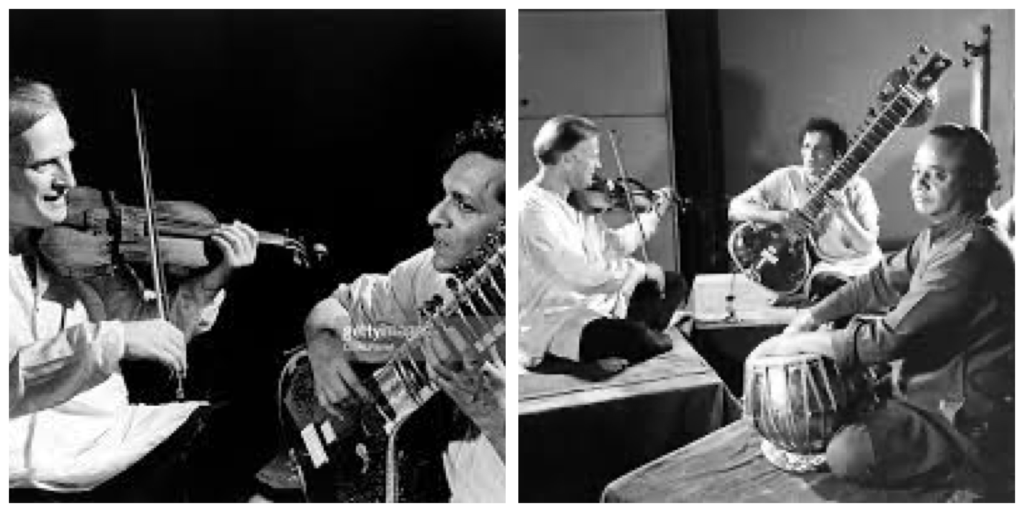
Throughout the 1940s and 50s, Menuhin performed and made recordings from the great works of the classical canon. During this time he also began to include rarely performed and lesser known works. One of his greatest achievements is the commissioning and performing of Sonata for Solo Violin by Bella Bartók. In Bartók, Menuhin found a composer of deep emotion and pathos that mimicked his own. Bartók’s work was at once technically rigorous and open to interpretive playing. Of Menuhin, Bartók said he played better than he imagined he would ever hear his work played. Their collaboration is considered one of the greats of twentieth-century classical music. By the sixties, Menuhin began to increase the scope of his musical involvement. In 1963 he opened the Yehudi Menuhin School, a school for musically gifted children. He also began conducting, which he would continue to do until his death. He conducted in many of the important music festivals and nearly every major orchestra in the world. It was around this time he also broke from his traditional roots and did work outside of the classical genre. One of his most successful ventures out of traditional performance was with the great Indian composer and sitarist Ravi Shankar.

Menuhin’s partnership with Grappelli began in the early 1970s when they performed together on the Michael Parkinson Show. Their collaboration resulted in three albums, where Menuhin played classical parts while Grappelli improvised jazz elements. Menuhin admired Grappelli’s improvisational skills, describing him as a “juggler” capable of balancing musical themes seamlessly. Their performances were a blend of classical precision and jazz spontaneity and their collaborations bridged the gap between classical and jazz music, creating a unique musical coolboartion that resonated with audiences worldwide. Stéphane Grappelli was born in 1908 in Paris and became a pioneering French jazz violinist. He co-founded the Quintette du Hot Club de France with guitarist Django Reinhardt in 1934, creating one of the first all-string jazz band. Grappelli’s career spanned nearly seven decades and was known for his collaborations with various musicians including Duke Ellington and Oscar Peterson. Alan Clare was an original member of the Holland Park Set in London that included, Peter Sellers, Spike Milligan, Stéphane Grappelli and Harry Secombe. He also appeared on television in the 1960s and 1970s, alongside comedian Spike Milligan and in 1961, composed the music for the feature film, Seven Keys. Clare performed with Stephane Grappelli during the 1940s and were reunited with Grappelli for their recordings with Yehudi Menuhin
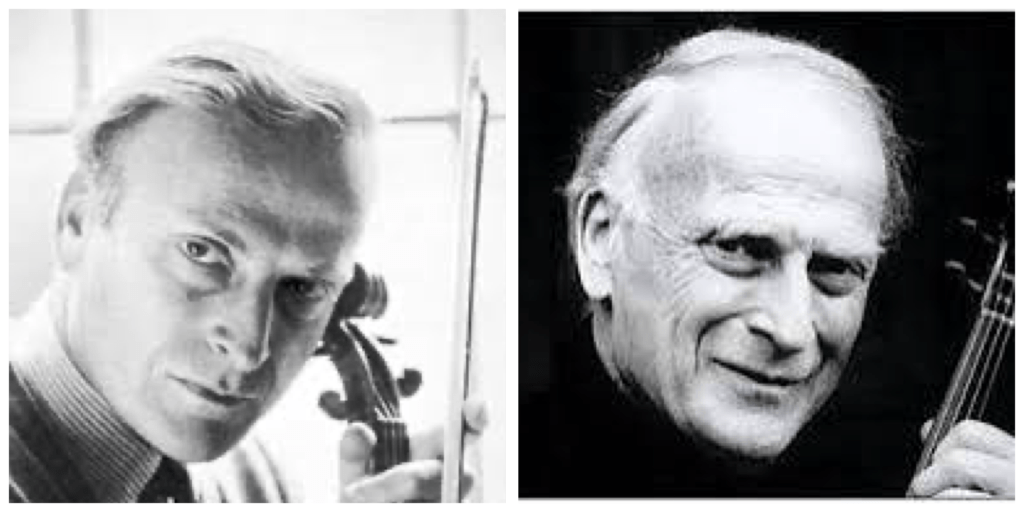
At the peak of his form he gave astonishing performances that seemed effortless, sincere and completely natural. That said, the pyrotechnics of violin playing were to become a major problem for much of his later career. By his own admission his technique had evolved naturally out of a compelling desire to make music at an astonishing level of maturity for one so young. It was the realisation that he could not continue indefinitely surviving on inspiration and adrenaline alone that he now began, in effect, relearning the instrument in an attempt to rationalise what had so far come completely naturally. The pull between Menuhin the supremely natural musician and Menuhin the executant violinist lies at the heart of the problems that would occasionally beset him in later life. By the 1970s his concert appearances ranged from blazing triumphs compromised by technical discomfort. On occasions, Menuhin’s technique was not perfect and his intonation could be rather suspect yet none of this seemed to matter given Menuhin’s profound artistry and mesmerising stage presence.
Yehudi Menuhin’s recording of Tchaikovsky’s Violin Concerto in D major, Op. 35 with the Royal Philharmonic Orchestra, conducted by Sir Adrian Boult, was recorded on February 17 and 18, 1959, at Kingsway Hall in London.

Leave a comment