
Mother Nature has always been an inspiration to composers for the last 800 years. Some of the most spectacular music has been inspired by storms. Hang on to your hats and enjoy some remarkable music
Joseph Haydn (1732-1809)
Symphony No 8 in G Major (1761)
IV. La tempesta: Presto
Academy of St Martins-in-the-Fields
Sir Neville Marriner (conductor)
Nikolai Rimsky-Korsakoff (1844-1908)
Scheherazade (1888)
I. The Sea and Sinbad’s Ship
New York Philharmonic Orchestra
Alan Gilbert (conductor)
Benjamin Britten (1913-1976) (1945)
Peter Grimes
IV. Storm from Four Sea Interludes
BBC Symphony Orchestra
Andrew Davis (conductor)
Gioccomo Rossini: (1792-1868)
Overture to William Tell (1829)
Orchestra of Santa Cecilia
Antonio Pappano (conductor)
Johann Strauss (1825-1899)
Thunder and Lightning Polka Op 325 (1868)
Vienna Johann Strauss Orchestra
Joseph Francek (conductor)

Joseph Haydn (1732-1809)
Symphony No 8 in G Major (1761)
Joseph Haydn began his prolific symphonic career after turning 30, composing over 100 symphonies. Prior to this, he explored various musical forms, including keyboard sonatas, divertimentos, concertos, church music, and his first string quartets in 1756. These early quartets were created while Haydn worked for Carl Joseph von Fürnberg, who provided modest musical resources. His subsequent patron, Count Morzin, allowed him to experiment with larger ensembles and symphonies until financial troubles forced the disbandment of Morzin’s orchestra in 1761. Haydn then secured a prestigious position with the Esterházy family as Vice-Kapellmeister, initiating a 30-year collaboration. In 1761, Haydn composed a symphonic trilogy—Symphony No. 6 (Le matin), Symphony No. 7 (Le midi), Symphony No. 8 (Le soir) that depict the progression of the day, with each symphony representing a different time: morning, noon, and night.The eighth symphony portrays the evening with its finale offering us a storm which reflected the pastoral tradition of the times. Le Matin, Le Midi, and Le Soir were commissioned by Prince Paul II Anton Esterházy and premiered at Esterházy Palace. They blended Baroque concerto grosso elements with Classical symphonic forms, elevating supportive instruments like bassoons and double basses to melodic prominence.The trilogy enabled the Esterházy Orchestra to display its technical prowess and solidified Haydn’s reputation as a symphonic innovator, influencing composers like Mozart and Beethoven. The fourth movement (La tempesta) is playful depiction of a storm using rapid string arpeggios, chromatic scales, and virtuosic violin passages, marking Haydn’s mastery of thematic surprises and orchestral innovation.

Nikolai Rimsky-Korsakoff (1844-1908)
Scheherazade (1888)
Scheherazade is based on The Thousand and One Nights, a collection of Middle Eastern and Indian fairy tales. The story centres on Sultan Shahriar, who, after being betrayed by his wife, executes a new bride each morning until Sultana Scheherazade saves herself by telling captivating stories over 1,001 nights. Scheherazade’s storytelling delays her execution, eventually leading the Sultan to fall in love with her and abandon his violent plan. Rimsky-Korsakov composed Scheherazade in 1888 as a symphonic suite in four movements, unified by recurring themes and motifs.The suite’s movements include:
The Sea and Sindbad’s Ship
The Story of the Kalandar Prince
The Young Prince and the Young Princess
Festival at Baghdad
Rimsky-Korsakov intended the movement titles as hints rather than strict narratives, emphasizing the work as an ‘oriental narrative’ of fairy-tale wonders. Scheherazade premiered in November 1888 in St. Petersburg with the composer conducting. Rimsky-Korsakov played a pivotal role in shaping Russian classical music by incorporating folk melodies and themes from Russian history and mythology into his works.His influence extended beyond Russia, impacting composers like Maurice Ravel and Ottorino Respighi. As a professor at the St. Petersburg Conservatory, he shaped the next generation of Russian composers, including Alexander Glazunov, Sergei Prokofiev, and Igor Stravinsky. His textbook on orchestration, completed by his son-in-law Maximilian Steinberg, remains a seminal work in the field. Rimsky-Korsakoff also edited and completed works by other composers, notably Modest Mussorgsky’s operas, which sometimes led to controversy due to significant changes he made. Through his compositions and educational endeavors, Rimsky-Korsakov left an enduring legacy in the world of classical music.
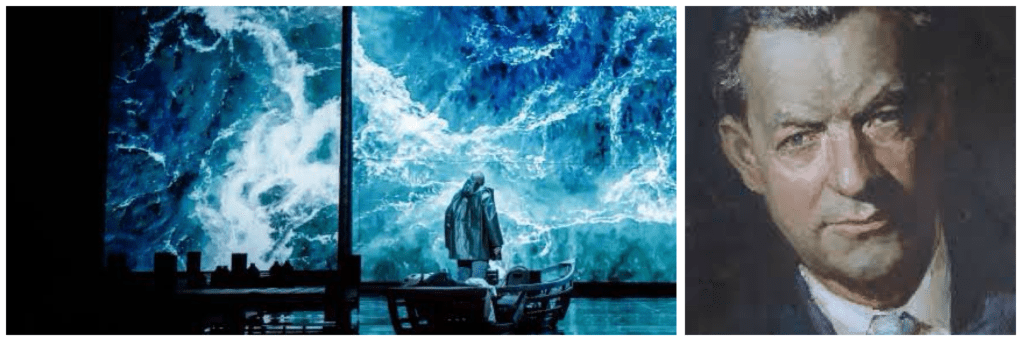
Benjamin Britten (1913-1976) (1945)
Peter Grimes IV. Storm from Four Sea Interludes
The Four Sea Interludes serve as scene changes in the opera, Peter Grimes – work was conceived while Britten was living in the US in the early years of the Second World War and completed when he returned to Britain in 1943. The Interludes: Dawn, Sunday Morning, Moonlight and Storm, allows the transition between physical locations whilst, at the same time, explores the characters’ emotional turmoil. Britten adapted them into self-contained concert pieces by rewriting their ending. In Act I, the Storm music transitions from Grimes waiting for the storm to arrive to the townspeople seeking shelter. The storm music subsides with a consoling theme that Grimes sings about seeking peace from turmoil, and it is his final song before his tragic end. Britten was born on November 22, 1913, in Lowestoft, Suffolk. He began composing at age five and by fourteen had written over 100 works. His mother encouraged his musical development, and he started formal composition lessons with Frank Bridge in 1927. He was prolific in the 1930s and 1940s, producing incidental music for films, plays, and radio. Britten’s first opera, Paul Bunyan (1941), was performed in the U.S. and on his, return to England, it led to the creation of Peter Grimes (1945), which established him as a leading composer. In his later years, Britten developed a sparer style, evident in works like Curlew River (1964) and Death in Venice (1973). His final compositions, such as Phaedra (1975) and the Suite on English Folk Tunes (1974), reflect a confrontation with mortality. Many of his works have now secured a place in the classical repertoire. Britten is regarded as one of the most influential composers of the 20th century, with his operas considered among the finest since Henry Purcell. He was the first composer to be honored with a life peerage by the Queen.

Gioccomo Rossini: (1792-1868)
Overture to William Tell (1829)
The Overture to William Tell premiered in Paris on August 3, 1829, as part of Rossini’s last opera, William Tell. Famously known for its final three minutes, which became the theme music for a well known 1950’s TV series entitled The Lone Ranger. Rossini borrowed the overture from his earlier opera, Elizabeth, Queen of England, composed 14 years prior. The melodies are not derived from William Tell itself. The overture is divided into four parts: Dawn, Storm, Pastoral Scene and Cavalry Charge. Despite the opera’s initial criticism for its length, William Tell became highly successful, allowing Rossini to retire on its proceeds. The overture remains one of the most recognisable pieces in classical music, often used in popular media. Rossini was born on February 29, 1792, in Pesaro, Italy, to a family of musicians. His father was a trumpeter, and his mother was a singer. Rossini began composing at age 12 and entered the Philharmonic School in Bologna at 14. His first opera Demetrius and Polybius, was composed in 1806 first comic opera, The Marriage Contract, was performed in 1810. In 1815, he became the musical director of two opera houses in Naples, producing operas like Elizabeth, Queen of England and The Barber of Seville (1816). Rossini moved to Paris in 1823, where he composed Seige of Corinth (1826) and his final opera, William Tell (1829). His comic operas include The Barber of Seville, Cinderella and The Italian Girl in Algiers and his serious operas are Tancredi, Otello, Semiramide and William Tell. Other Works include Petite messe solennelle (1864), and Stabat Mater (1842). Rossini retired from large-scale composition at the young age 37 after William Tell. Spent his later years in Paris, composing smaller pieces and enjoying social life. His operas experienced a revival in popularity from the 1950s
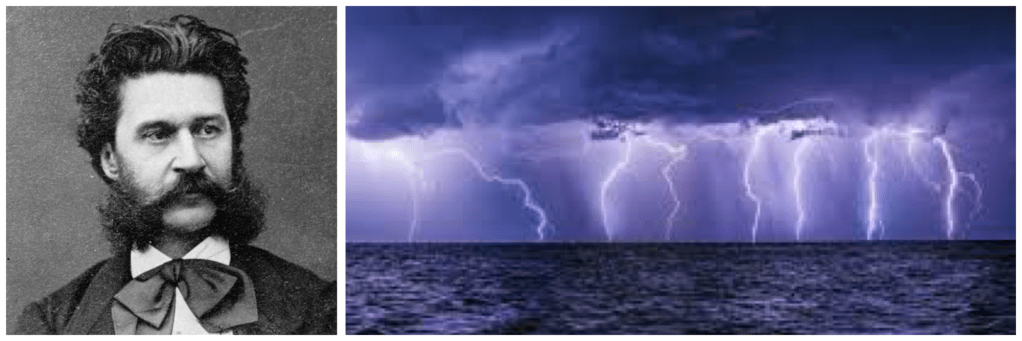
Johann Strauss (1825-1899)
Thunder and Lightning Polka Op 325 (1868)
Composed in 1868, the Thunder and Lightning Polka is one of Strauss’s most illustrative works, evoking natural phenomena through music. The polka features energetic and lively rhythms, with bass drum rumblings, bright cymbal clashes, and flashing woodwind figures that vividly depict thunderstorms. It remains a popular choice for orchestral performances and embodied the spirit of Viennese dance music Born in 1825, in Vienna, his father’s wish was for him to pursue a career in banking. However, Strauss secretly studied the violin and began conducting his own dance band in 1844. After his father’s death in 1849, Strauss combined his orchestra with his own and toured extensively, including performances in Russia and England. In 1870, he handed over the orchestra to his brothers to focus on composition, leading to some of his most famous works. Strauss’ waltzes include The Blue Danube, Morgenblätter, Artist’s Life,Tales From the Vienna Woods, Woman and Song, Wiener Blut, and Emperor’s Waltz. His operettas are Die Fledermaus, The Gypsy Baron, Der Karneval in Rom, and Eine Nacht in Venedig. Strauss composed over 500 dance pieces, including more than 150 waltzes, and is still a household name known for his contributions to Viennese operetta and dance music.


Leave a comment