
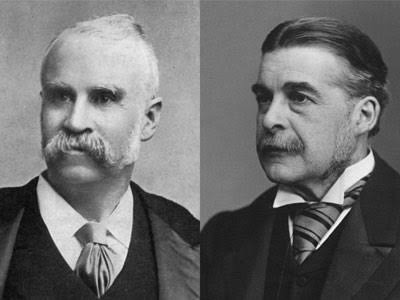
Sir William Gilbert (1836-1911) Librettist
Sir Arthur Sullivan (1842-1900) Composer
Gilbert and Sullivan were a Victorian-era theatrical duo consisting of librettist W. S. Gilbert and composer Arthur Sullivan, who collaborated from 1871 to 1896 to create fourteen comic operas. Their works are renowned for witty, satirical libretti and memorable music. Among their best-known operas are H.M.S. Pinafore, The Pirates of Penzance, and The Mikado. These operas are collectively known as the Savoy Operas, named after the Savoy Theatre, which was built by their producer Richard D’Oyly Carte specifically to stage their works.
Carte also founded the D’Oyly Carte Opera Company, which performed and promoted their operas for over a century. The Mikado was their longest-running hit, with 672 performances, and it remains one of the most frequently performed musical theatre pieces worldwide. Gilbert and Sullivan introduced innovations in both content and form that significantly influenced the development of musical theatre throughout the 20th century. Their operas combined sophisticated satire with engaging music, helping to bridge the gap between grand opera and modern musical comedy.
Their partnership ended due to disputes over Savoy Theatre expenses, but their operas continue to be performed globally and have left a lasting legacy on theatre, influencing political discourse, literature, film, television, and inspiring countless adaptations and parodies.
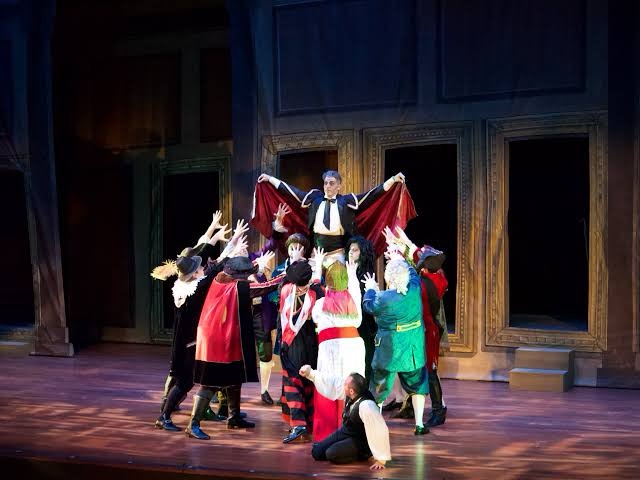
Overture to Ruddigore or The Witches Curse (1887)
Ruddigore; or, The Witch’s Curse is a comic opera in two acts that was first performed at the Savoy Theatre in London on 22 January 1887. It is the tenth of the fourteen operas created by Gilbert and Sullivan and features a cast of colourful characters including a villainous baronet, a virtuous maiden, a hero in disguise, ghosts, and a family curse. The opera is known for its humour, absurdity, and the supernatural element of ancestors’ ghosts coming to life.
At its premiere, Ruddigore received a mixed reception. Although it ran for a respectable 288 performances, it did not achieve the same level of success as The Mikado. One notable aspect of the opera is its overture. The original overture was replaced in a 1920 revival by a new arrangement created by Geoffrey Toye. This overture combines Sullivan’s melodic charm with a darker, more sombre tone that suits the opera’s parody of gothic melodrama. It effectively sets the mood for the unique blend of comedy and supernatural mystery that characterises the work.
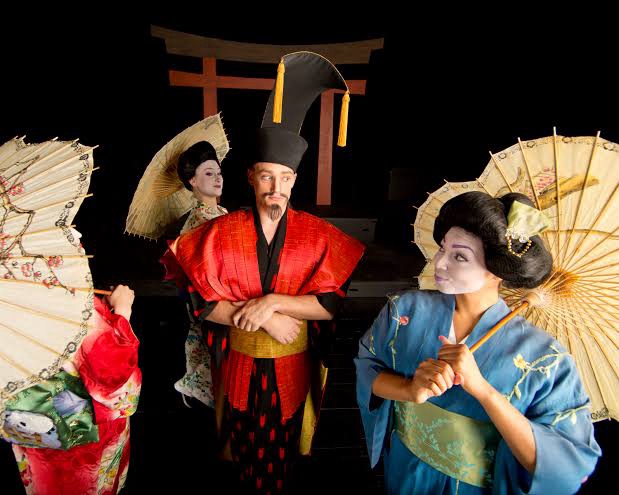
The Mikado (1885)
Act 2: 3; A Wandering Minstrel I
The Mikado is set in the fictional town of Titipu and follows Nanki-Poo, the Mikado’s son, who disguises himself to avoid marrying Katisha. He loves Yum-Yum, who is engaged to Ko-Ko, the Lord High Executioner. When the Mikado demands an execution within a month, Ko-Ko convinces Nanki-Poo to be the victim, allowing him one month of marriage first. Complications arise when Yum-Yum learns the wife of an executed man must be buried alive. To save her, Ko-Ko fakes Nanki-Poo’s death, but the Mikado uncovers the ruse. The conflict resolves when Ko-Ko agrees to marry Katisha, freeing Nanki-Poo and Yum-Yum to be together.
A Wand’ring Minstrel I is an aria from Act I of The Mikado, sung by the character Nanki-Poo, the disguised son of the Mikado. In this lively and charming number, Nanki-Poo describes himself as a wandering minstrel, a ‘thing of shreds and patches,’ who carries a varied repertoire of ballads, songs, and lullabies to suit every mood and occasion. The aria shows his versatility and readiness to entertain, ranging from patriotic ballads celebrating the troops of Titipu to sea shanties and love songs. It sets a lighthearted tone and introduces Nanki-Poo’s character as a romantic and resourceful figure within the opera’s satirical and whimsical world.
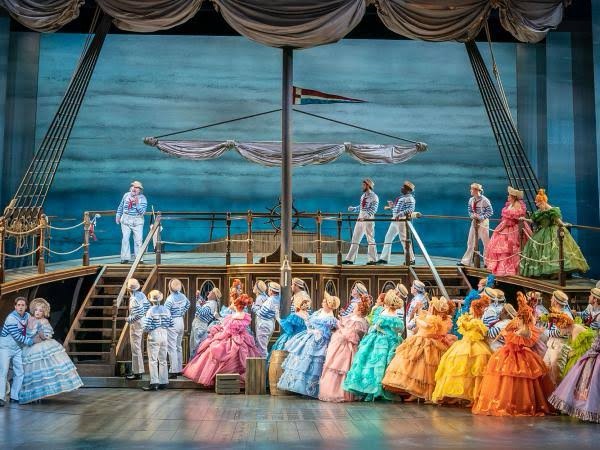
HMS Pinafore (1878)
Sorry Her Lot Who Loves Too Well
H.M.S. Pinafore; or, The Lass That Loved a Sailor is a comic in two acts that was first performed in London in 1878. The story is set aboard the British naval ship H.M.S. Pinafore, anchored off Portsmouth. The plot centres on Josephine, the captain’s daughter, who is in love with Ralph Rackstraw, a humble sailor, despite her father, Captain Corcoran, wishing her to marry Sir Joseph Porter, the First Lord of the Admiralty.
Through its humour and satire, the opera critiques social class distinctions, love, duty, and the British Navy, exploring themes of equality and social rank.
H.M.S. Pinafore was a major success and has had a lasting influence on the development of musical theatre, remaining popular worldwide. One memorable aria from the opera is Sorry Her Lot Who Loves Too Well, sung by Josephine in Act II. This poignant and lyrical number expresses her conflicted feelings about love, conveying sorrow and empathy for those who love deeply but suffer as a result. The aria provides a touching contrast to the generally comic tone of the opera and is considered one of its most beautiful and heartfelt moments.

Pirates of Penzance (1879)
Aria: I am the very model of a modern Major-General
The Pirates of Penzance; or, The Slave of Duty is a comic opera in two acts that premiered in 1879 in New York and was later performed in London in 1880. This witty and engaging operetta centres on themes of duty, love, and mistaken identity. The plot follows Frederic, who, due to a nursemaid’s mishearing, was mistakenly apprenticed to a band of tender-hearted pirates instead of a ship’s pilot. The opera uses humour and satire to explore ideas of duty and social conventions, blending clever dialogue with memorable music.
The story reaches a comic climax when Frederic discovers that his birthday falls on 29 February—Leap Day—meaning he has fewer birthdays and must remain bound to his pirate apprenticeship for longer. This twist leads to a series of amusing complications before the characters ultimately reconcile.
One of the opera’s most famous moments is the aria I Am the Very Model of a Modern Major-General, sung by Major-General Stanley in Act I as a self-introduction. This patter song is celebrated for its rapid delivery, clever rhymes, and humorous catalogue of the Major-General’s wide-ranging but superficial knowledge.
It satirises the Victorian British military officer stereotype—educated and confident, yet comically out of touch with practical matters. The lively tempo and intricate wordplay cover topics from history and mathematics to literature and classical music, highlights the Major-General’s boastful but shallow intellect. This aria has become one of the most iconic pieces in musical theatre, frequently referenced and parodied in popular culture.
The Pirates of Penzance is a clever and entertaining operetta about duty, love, and mistaken identity, with the Major-General’s aria standing out as a highlight for its humour, musical complexity, and sharp satire.
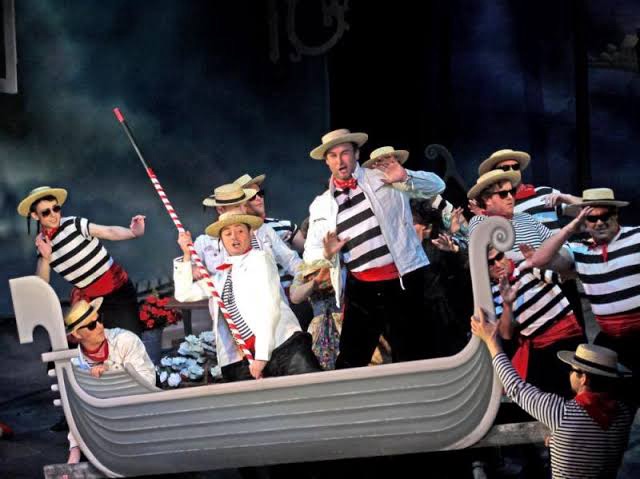
The Gondoliers (1889)
One More, Gondolieri
The Gondoliers follows two Venetian gondolier brothers, Marco and Giuseppe, who each marry a farm girl. Their lives change when they learn that one of them is the heir to the throne of Barataria, though it’s unknown which one. Despite being republicans, they agree to rule jointly until the true king is found, causing humorous chaos. Meanwhile, Casilda, betrothed to the king, loves Luiz, the Duke’s servant, unaware he is the real monarch switched at birth. When the truth emerges, Casilda and Luiz become king and queen, and Marco and Giuseppe return to their gondolier lives.
One More, Gondolieri is a lively ensemble number sung early in The Gondoliers by the gondoliers themselves, celebrating their camaraderie and the joyful life they lead on the canals of Venice. The chorus captures the spirit of Venetian gondoliers with its rhythmic, catchy melody and spirited chorus parts. It reflects the opera’s themes of brotherhood, merriment, and the simple pleasures of life, providing a cheerful contrast to the more complex royal intrigues that unfold later.
Bright and buoyant, One More, Gondolieri sets an upbeat tone for the opera, emphasising the gondoliers’ cheerful outlook and the festive atmosphere of Venice.
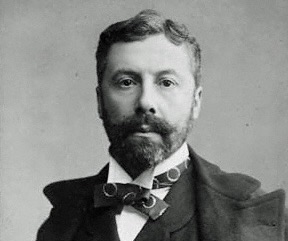
Richard D’Oyly Carte (1844–1901)
Richard D’Oyly Carte was a pivotal English impresario, talent agent, composer, and hotelier who significantly shaped Victorian musical theatre and hospitality. Initially a composer and music manager, he commissioned W. S. Gilbert and Arthur Sullivan to create the operetta Trial by Jury in 1875, which launched a highly successful collaboration. To produce these and other operettas, he formed the Comedy Opera Company, introducing works by composers such as Charles Lecocq and Jacques Offenbach to London audiences.
In 1881, Carte built the Savoy Theatre, the first London theatre equipped with electric lighting, which became the home of the celebrated Gilbert and Sullivan operas. He also founded the D’Oyly Carte Opera Company, dedicated to producing and promoting their works, which toured extensively in the UK, Europe, and North America, and remained active for over a century. Beyond theatre, Carte expanded into luxury hotels, constructing the Savoy Hotel adjacent to the theatre and acquiring prestigious establishments like Claridge’s and Simpson’s-in-the-Strand.
Carte also aspired to establish English grand opera, building the Royal English Opera House (later the Palace Theatre) and commissioning Sullivan’s Ivanhoe (1891), though this venture was short-lived. After his death, his widow Helen and their descendants continued managing the opera company, preserving and extending the legacy of Gilbert and Sullivan’s works. The D’Oyly Carte Opera Company pioneered both professional and amateur licensing of Gilbert and Sullivan operas and staged over 35,000 performances worldwide, influencing the course of modern musical theatre.
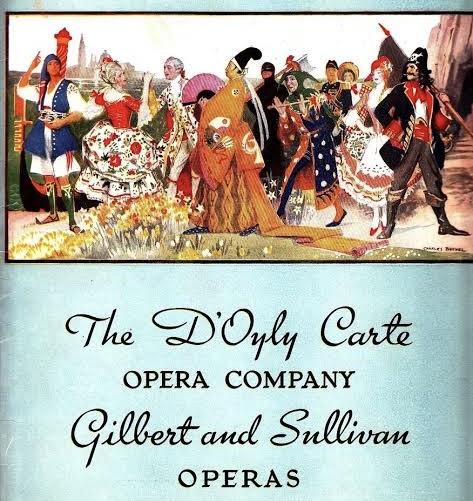
The 14 operas by Gilbert and Sullivan
Thespis, or The Gods Grown Old (1871)
Trial by Jury (1875)
The Sorcerer (1877)
H.M.S. Pinafore, or The Lass That Loved a Sailor (1878)
The Pirates of Penzance, or The Slave of Duty (1879)
Patience, or Bunthorne’s Bride (1881)
Iolanthe, or The Peer and the Peri (1882)
Princess Ida, or Castle Adamant (1884)
The Mikado, or The Town of Titipu (1885)
Ruddigore, or The Witch’s Curse (1887)
The Yeomen of the Guard, or The Merryman and his Maid (1888)
The Gondoliers, or The King of Barataria (1889)
Utopia, Limited, or The Flowers of Progress (1893)
The Grand Duke, or The Statutory Duel (1896)


Leave a comment