
Aram Khachaturian is widely recognised as the most renowned Armenian composer of the twentieth century, celebrated in his homeland as a true national treasure. His musical style was marked by colourful harmonies, rhythmic vitality, virtuosic passages, and sensuous, sweeping melodies. Deeply influenced by the musical traditions of his heritage, Khachaturian seamlessly blended Armenian, Caucasian, Eastern and Central European, and Middle Eastern folk music with the Russian classical tradition.
Born and raised in Tbilisi, the capital of present-day Georgia, Khachaturian was the youngest of five children. He initially considered a career in medicine or engineering but instead pursued studies in biology at Moscow State University after moving to Moscow in 1921. Alongside his university studies, he learned to play the cello under the guidance of Sergei Bychkov and Andrey Borysyak. His growing passion for music led him to the Gnessin Musical Institute, where he joined Mikhail Gnessin’s composition class. Among his early works from this time are the Dance Suite (1926) and Poem in C-sharp minor (1927). In 1929, Khachaturian was accepted into the Moscow Conservatory, where he studied composition under Nikolai Myaskovsky and orchestration with Sergei Vasilenko.
Aram Khachaturian (1903-1978)
Gayane (1942): Sabre Dance
Mariinsky Orchestra
Valerie Gergiev (conductor)
Aram Khachaturian (1903-1978)
Spartacus (1954) Adagio
Vienna Philharmonic Orchestra
Aram Khachaturian (conductor)
Aram Khachaturian (1903-1978)
Cello Concerto (1946)
Dmitri Yablonsky (cello)
Moscow City Symphony Orchestra
Maxim Fedotov (conductor)
Aram Khachaturian (1903-1978)
Masquerade Suite (1941) Galop
Moscow RTV Orchestra
Aram Khachaturian (conductor)
Aram Khachaturian (1903-1978)
Symphony No 3 (Finale)
BBC Philharmonic Orchestra
Fedor Gluschenko (conductor)
Khachaturian’s first major triumph came with the Piano Concerto in 1936, a work that garnered acclaim both within the Soviet Union and abroad. In 1939, following a research trip to Armenia where he immersed himself in Armenian folk music, Khachaturian composed the ballet Happiness, which he later reworked into the widely celebrated ballet Gayane (1942). Other major successes from this period include the Violin Concerto (1940), written for David Oistrakh and awarded the prestigious Stalin Prize, and the Cello Concerto (1946).

Aram Khachaturian (1903-1978)
Gayane (1942): Sabre Dance
Gayane is a four-act ballet that premiered on December 9, 1942, performed by the Kirov Ballet in Perm, Russia. The story follows Gayane, a young Armenian woman whose husband, Giko, is involved in crimes such as kidnapping, arson, and smuggling. Despite these immense challenges, Gayane ultimately overcomes her hardships and finds happiness when she marries a Red Army Border Guard who helped her confront her troubles. The ballet artfully blends Soviet themes with the vibrant elements of Armenian folk culture. Khachaturian revised the work several times, with the 1952 version now regarded as the definitive edition.
One of the ballet’s most iconic pieces is the Sabre Dance, which features in the final act. Originally titled the Dance of the Kurds, it was introduced at the insistence of the Kirov Theatre’s director late in the production process. The piece is distinguished by its energetic, driving rhythms and striking use of percussion – especially the xylophone – which is meant to evoke the spirit of Kurdish Peshmerga fighters, although the music itself does not closely mirror traditional Kurdish music.
The Sabre Dance became not only the most famous excerpt from Gayane, but also Aram Khachaturian’s most celebrated and widely recognized composition worldwide, gaining immense popularity through countless pop arrangements, as well as frequent appearances in films, television shows, and figure skating programmes.
Throughout his career, Khachaturian took on important leadership roles in the Union of Soviet Composers and formally joined the Communist Party in 1943. For much of his career, Khachaturian enjoyed the support of the Soviet government. The premiere of Gayane during World War II was a major patriotic event, earning him a first-class Stalin Prize – an honor he shared with his countrymen by donating the prize money to fund tank production.
Aram Khachaturian (1903-1978)
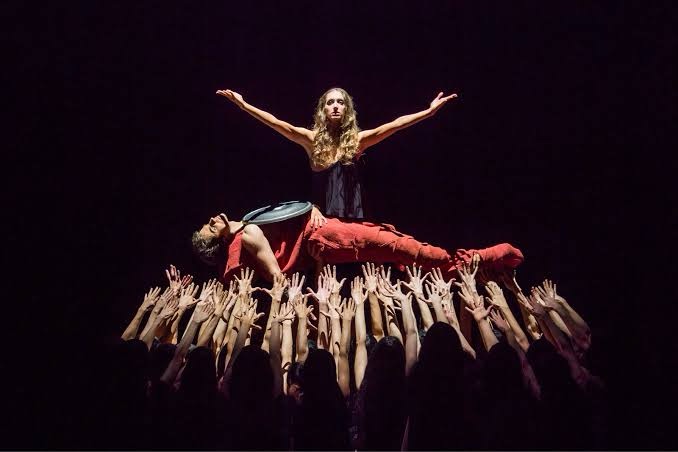
Spartacus (1954) Adagio of Spartacus and Phrygia
Spartacus is a ballet in three acts that first premiered in 1956 at the Kirov Theatre in Leningrad. Its story is inspired by the historical slave uprising led by Spartacus, the Thracian king who was captured and forced into life as a gladiator. As the narrative unfolds, his wife Phrygia is torn from him and given to another as a concubine, deepening his anguish and resolve. Spartacus, determined to reclaim his freedom and love, rallies his fellow slaves and leads a daring revolt against their Roman oppressors. Their struggle is fierce and impassioned, marked by moments of both violence and tenderness. Despite his courage and strength, Spartacus is ultimately betrayed and killed.
The Adagio of Spartacus and Phrygia stands out, capturing the lovers’ bittersweet reunion through swelling string arrangements and gentle flute melodies – a testament to Khachaturian’s evocative music.
The ballet’s libretto was crafted using historical sources, as well as influenced by Soviet artistic ideals. To this, fictional elements were added, including the character Aegina, whose presence epitomizes the decadence of Rome. At its core, Spartacus is a story about love, loyalty, rebellion, and the perpetual struggle against oppression. Adagio of Spartacus and Phrygia remains one of his most beloved and enduring compositions, emblematic of the ballet’s enduring power.
Aram Khachaturian (1903-1978)
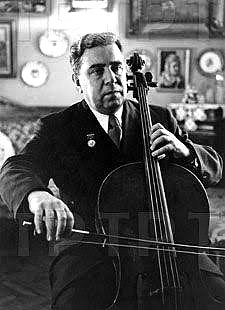
Cello Concerto (1946)
Aram Khachaturian composed his Cello Concerto in E minor in 1946 specifically for the cellist Sviatoslav Knushevitsky, a member of a renowned Soviet piano trio that included violinist David Oistrakh and pianist Lev Oborin. This concerto was the final piece in a set of three concertos Khachaturian wrote for each individual member of this trio, following the Piano Concerto for Oborin and the Violin Concerto for Oistrakh. Although the Cello Concerto was the last to be completed, Khachaturian had originally considered writing a cello concerto early during his own cello studies.
The premiere took place in late October 1946 at the Moscow Conservatory’s Great Hall, with Knushevitsky as the soloist and Aleksandr Gauk conducting. The work blends Armenian folk elements, notably the influence of the ashoug style (traditional Armenian folk singers and poets), along with dance rhythms, and it is frequently described as having a more symphonic character than a conventional concerto.
Structured in three movements—Allegro moderato, Andante sostenuto, and Allegro (a battuta) – the concerto opens with a brooding first movement that incorporates the somber Dies Irae motif and includes a lengthy cadenza but relatively sparse thematic development. The second movement is introspective and melancholic, with an Oriental character marked by its nocturnal and menacing qualities. The energetic final movement builds tension before concluding with a lively coda.
Khachaturian’s Cello Concerto remains less well-known and less frequently performed than his violin and piano concertos, partly due to its darker emotional tone and because it was criticized under Soviet authority for formalism, leading to Khachaturian’s denunciation in the 1948 Zhdanov Decree. This political repression contributed to its limited entry into the core cello repertoire despite its comparable technical demands to the other two concertos.

Aram Khachaturian (1903-1978)
Masquerade Suite (1941) Galop
Masquerade Suite was composed in 1941 as incidental music for Mikhail Lermontov’s play Masquerade. In 1944, Khachaturian arranged it into a five-movement orchestral suite consisting of a Waltz, Nocturne, Mazurka, Romance, and Galop. The music mirrors the tragic story of jealousy and misunderstanding in the play, where a woman is falsely accused of infidelity and ultimately killed by her husband. The suite premiered on June 21, 1941, at the Vakhtangov Theater in Moscow, although the performance run was cut short by the German invasion of the Soviet Union. The final movement, the Galop, is a lively and fast-paced dance that contrasts with the more lyrical and somber earlier movements, providing an energetic conclusion. Today, the Masquerade Suite remains one of Khachaturian’s most popular orchestral works, frequently performed and recorded.

Aram Khachaturian (1903-1978)
Symphony No 3 (Finale)
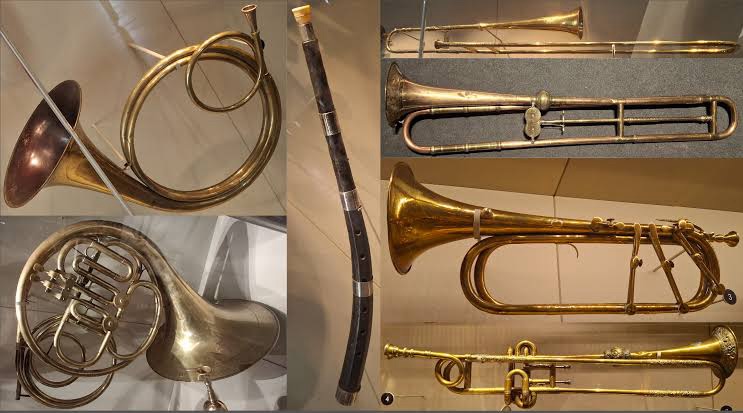
Symphony No. 3, subtitled Symphony–Poem, was composed in 1947 to commemorate the 30th anniversary of the Russian Revolution. It premiered on December 13, 1947, in Leningrad, performed by the Leningrad Philharmonic Orchestra under the direction of Yevgeny Mravinsky. However, the premiere was not considered successful. Although intended as a hymn of praise to the Soviet Union, the work was met with dissatisfaction from Stalinist cultural authorities due to its raw, strident style, unorthodox structure, and unusual instrumentation. It was condemned as formalistic in the 1948 Zhdanov decree, and the concert hall was reportedly half-empty at the premiere, reflecting the poor reception. The symphony is a single-movement work featuring unusually large and distinctive orchestration, including an organ solo and fifteen trumpets. With its daring instrumentation and intense emotional expression, Symphony No. 3 was Khachaturian’s final symphonic composition.
In Conclusion
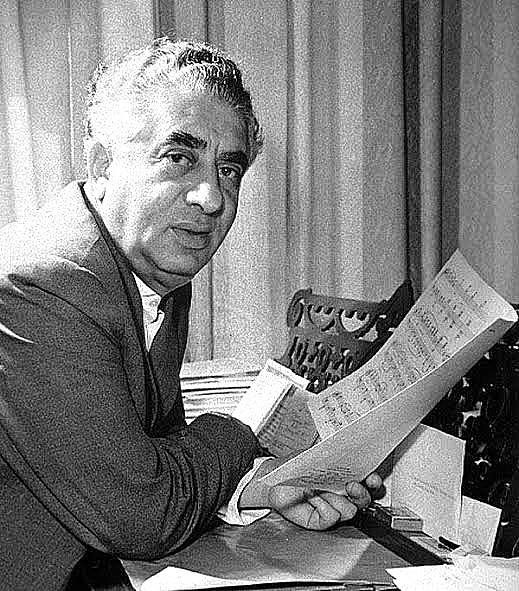
In 1948, Khachaturian was publicly denounced by Soviet authorities as a ‘formalist,’ accused of creating music deemed elitist and insufficiently aligned with Soviet ideology. Branded as composing ‘anti-people’ music, he was censored and humiliated, compelled to apologise publicly and sent to Armenia as a form of punishment. Yet, by the end of that year, he was largely restored to official favor.
In the 1950s, Khachaturian devoted more time to teaching and conducting. He began teaching at both the Gnessin Institute and the Moscow Conservatory while also focusing on conducting and cultural diplomacy. In 1954, he was awarded the title of People’s Artist of the USSR, and in 1957 he became Secretary of the Union of Soviet Composers, a post he held until his death. From the late 1950s onward, Khachaturian traveled extensively, serving as a musical ambassador to Europe, Latin America, and the United States—his 1968 US tour being especially noteworthy.
In his later years, Khachaturian composed rhapsodies for violin, cello, and piano (1960s), as well as solo sonatas for cello, violin, and viola (1970s). He achieved a series of ‘firsts’ for Armenian music, creating the country’s earliest ballet music, symphony, concerto, and film score. Throughout the twentieth century and beyond, Aram Khachaturian’s vibrant, distinctive, and emotionally charged music has continued to captivate audiences around the world.

Leave a comment