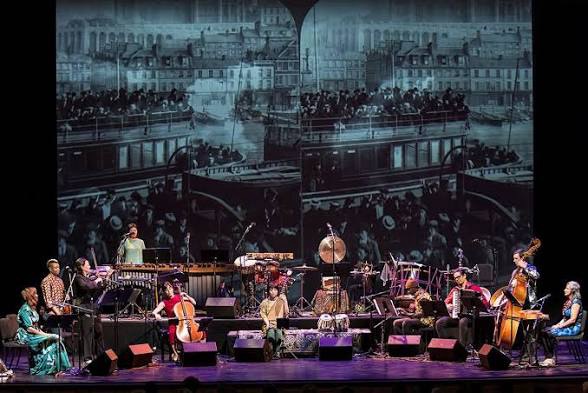
In 1998, cellist Yo‑Yo Ma launched the Silk Road Project, a nonprofit dedicated to stimulating cultural exchange through the arts. Its mission is to build bridges between cultures, which inspired the creation of the Silk Road Ensemble two years later – a groundbreaking collective uniting musicians from over 20 countries along the historic Silk Road. The core idea was simple yet powerful: let music serve as a bridge to foster collaboration, creativity, and mutual understanding across borders.
David Bruce (b. 1970)
Cut The Rug: Drag The Goat (2013)
The Silk Road Ensemble
Zhao Lin (b. 1973)
Battle Remembered (2004)
The Silk Road Ensemble
Hoagy Carmichael (1899-1991)
Heart and Soul (1938)
The Silk Road Ensemble
Sandeep Das, Joseph Gramley, Dong-Won Kim, Shane Shanahan, and Mark Suter
Vocussion (2009)
The Silk Road Ensemble
Kayhan Kalhor (b. 1963)
Gallop of a Thousand Horses (2005)
The Silk Road Ensemble
Yo-Yo Ma: A Life Dedicated to Cultural Exchange
Born in Paris to Chinese parents, Yo-Yo Ma moved to the United States at the age of five and quickly became one of the most celebrated cellists of his generation. His upbringing, which straddled both Eastern and Western cultures, gave him a deep appreciation for music’s power to transcend boundaries. Yo-Yo Ma founded the Silk Road Ensemble based on his conviction that music could serve as a universal language, initiating dialogue and bridging cultures. The Ensemble brought together musicians from China, Iran, India, Spain, Syria, the United States, and other countries to collaborate, perform, and craft new works.
The Mission of the Silk Road Ensemble
Yo Yo Ma reflects in his 2008 TED Talk, The Power of Culture to Create a Better Future, that ‘Culture is the way we express our humanity, and music is one of the most powerful ways to do that.‘ The Silk Road Ensemble embodies this philosophy, proving that music can be a transformative force for unity in a fragmented world.
The Musicians of the Silk Road Ensemble
The Silk Road Ensemble is a dynamic group of over 50 musicians, composers, and artists from around the world. While the lineup varies by project, its core members represent a wide array of musical traditions and instruments, each contributing a unique voice that reflects the Ensemble’s commitment to cultural diversity and collaboration. It’s members include:
- Yo-Yo Ma (Cello, USA/China)
- Rhiannon Giddens (Banjo/Voice, USA)
- Kayhan Kalhor (Kamancheh, Iran)
- Wu Man (Pipa, China)
- Cristina Pato (Gaita, Spain)
- Sandeep Das (Tabla, India)
- Kinan Azmeh (Clarinet, Syria)
- Shane Shanahan (Percussion, USA)
The Silk Road Ensemble’s Repertoire: Five Iconic Works
David Bruce: Cut The Rug: Drag The Goat (2013)
David Bruce’s piece draws inspiration from Buzkashi, the rough-and-tumble Central Asian sport in which riders on horseback fight to snatch a goat carcass and claim victory. The music mirrors that chaotic energy with fast, uneven rhythms and sudden bursts of sound. Moments of improvisation let the performers capture the sport’s unpredictable spirit. At the same time, instruments like the dutar and sato gently fuse folk traditions with the colours of contemporary classical music.
Zhao Lin: Battle Remembered (2004)
Zhao Lin’s Battle Remembered reflects on the Silk Road’s turbulent history – a combination of trade, war, and cultural exchange – evoking both the sorrow of conflict and the resilience of those who endured it. The composition centres on a dialogue between the erhu and cello. The erhu’s glissandi and the cello’s rich resonance create a piece that weaves traditional Chinese scales and Western harmonies into a reflective, memorable work.
Hoagy Carmichael: Heart and Soul (1938, arr. 2016)
This arrangement, featuring Lisa Fischer and Gregory Porter, reimagines Carmichael’s classic as a fusion of American jazz with Persian, Chinese, and Indian musical traditions. Fischer’s improvisations and Porter’s rich baritone seamlessly blend, beautifully integrating microtonal Persian modes, Chinese pentatonic scales, and Indian rhythmic complexity.
Sandeep Das, Joseph Gramley, Dong-Won Kim, Shane Shanahan, and Mark Suter: Vocussion (2009)
Vocussion is a lively, creative piece created by five Ensemble members. It mixes rhythms from around the world – like Afro-Cuban beats and Middle Eastern patterns – with scat singing and vocal percussion, making a rich and exciting sound. The Ensemble’s love of teamwork and connecting cultures turns voices into both instruments and storytellers. With its catchy energy and layered rhythms, Vocussion shows how music can bring different traditions together in a joyful way.
Kayhan Kalhor: Gallop of a Thousand Horses (2005)
Gallop of a Thousand Horses is a rhythmically charged composition by Kayhan Kalhor, one of Iran’ greatest kamancheh (spiked fiddle) players. Inspired by the image of wild horses racing across the Central Asian steppes, the piece captures both the raw power and poetic grace of Persian classical music. Kalhor’s innovative approach blends traditional Persian modes (dastgāh) and improvisational techniques with contemporary textures, creating a sound that feels both ancient and modern.
The Impact of the Silk Road Ensemble
The Ensemble has significantly influenced cultural exchange through programmes like Silkroad Connect and the Global Musician Workshop, alongside university residencies which fosters cross-cultural learning and awareness of the group’s work.
Conclusion
The Silk Road Ensemble’s repertoire is a testament to the power of music to bridge cultures and connect people. As the Ensemble continues to perform, record, and educate, it carries forward the legacy of the Silk Road. It reminds us that even in a modern, fractured world, music still has the power to inspire, connect, and unite people of all cultures.

Leave a comment