
Culminating in rich portrayals of Scheherazade by Rimsky-Korsakov and Ravel, the ‘exotic’ Orient inspired countless composers. Whilst it could be argued that some of the compositions allegedly reflect a patronising attitude, or perhaps a ‘western view’ of the East, this influence has left a remarkable wealth of music for us to enjoy. Composers born in the Middle East are now recognised as some of our finest composers. In Conversation explores some of the music and composers who bring the rich culture of the Middle East to their classical compositions.
Carl Maria Weber (1786-1826)
Abu Hassan Overture
Munich State Opera Orchestra
Wolfgang Sawallisch (conductor)
Gabriel Yared (b.1949)
New Dreams
Lyndhurst Orchestra
Gabriel Jared (conductor)
Wolfgang Amadeus Mozart (1756-1791)
Die Entführung aus dem Serail: March! March! March!
Les Arts Florissants
William Christie (conductor)
Maurice Ravel (1875-1937)
Shéhérazade: La flûte enchantée
Anne Sophie van Otter (soprano)
The Cleveland Orchestra
Pierre Boulez (conductor)
Naji Hakim (b. 1955)
Hymne au Sacre-Coeur
International Celebrity Trumpet Ensemble
Bruce Grindlay (organ)
Paul Archibald (director)
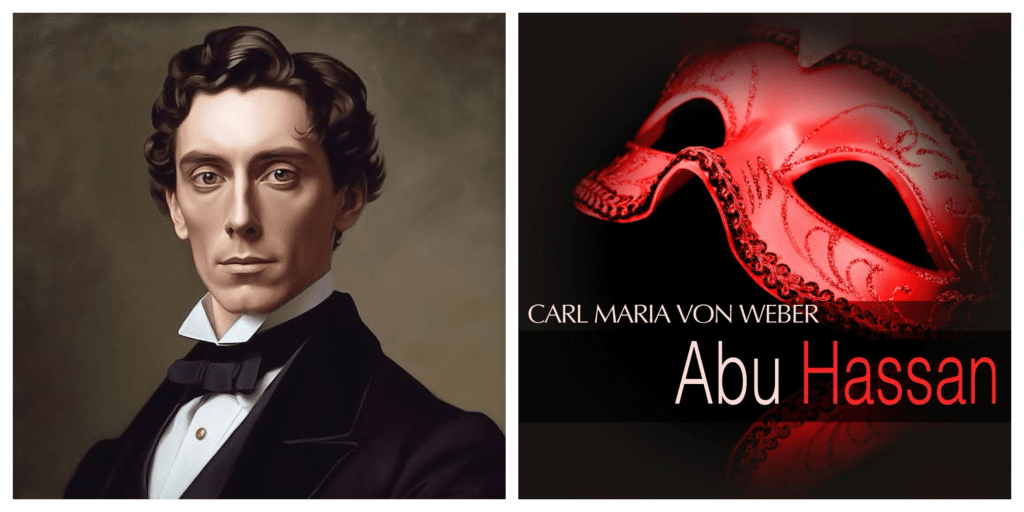
Carl Maria Weber’s Abu Hassan is a comic opera based on a tale from One Thousand and One Nights.
The story is a collection of Middle Eastern folktales compiled in the Arabic language during the Islamic Golden Age, a period of scientific, economic and cultural flourishing in the history of Islam, traditionally dated from the 8th-13th century.
Abu Hassan is a favorite of the Caliph of Baghdad but finds himself heavily in debt. He and his wife, Fatime, devise a scheme to fake their deaths to extract funeral money from the Caliph.
The premiere to place in Munich in 1811 and was conducted by Weber himself.
Abu Hassan is not commonly performed today but the overture remains well-known in the concert hall and has been recorded many times by some of the world’s greatest orchestras.
Weber played a significant role in the transition from Classical to Romantic music and his works significantly influenced subsequent German composers, including Meyerbeer and Wagner.
His compositions for piano made an impact on Mendelssohn, Chopin, and Liszt.
His operas are highly regarded with Der Freischütz (1821) becoming the most popular German opera of its time.
Besides operas, Weber composed symphonies, concertos, piano pieces, and compositions featuring the clarinet.

Gabriel Yared’s New Dreams is a track composed for the original motion picture score of the movie Message in a Bottle, released in 1999 starring Kevin Costner, Robbie Coltrane, Paul Newman.
The score was composed, co-orchestrated, co-produced, and performed by Gabriel Yared.
Yared’s score for Message in a Bottle is known for extending the style of Yared’s classical approach to film score writing and contributes significantly to the movie’s poignant atmosphere.
Gabriel Yared is a distinguished Lebanese-French composer renowned for his music for both French and American cinema.
His early career included arranging music for Italian singer Mina and collaborating with notable artists like Charles Aznavour and Françoise Hardy.
He gained international recognition for his work with director Anthony Minghella, scoring films such as The English Patient (1996), for which he won an Academy Award for Best Original Score.
Other notable scores include The Talented Mr. Ripley (1999) and Cold Mountain (2003), both of which earned him Academy Award nominations.
Beyond film scores, Yared has also composed ballets and established the Pléiade Academy to support young composers.
His work seamlessly blends classical and contemporary styles.

Mozart’s Die Entführung aus dem Serail (The Abduction from the Seraglio), K. 384, is a singspiel (a form of German light opera, typically with spoken dialogue) in three acts premiered in 1782 in Vienna.
Marsch! Marsch! Marsch! (March! March! March!) is part of Act: 1 and sets the stage for the drama that unfolds in the seraglio of Pasha Selim.
Marsch! Marsch! Marsch is typically Mozartian in its clarity, wit, and vivacity and it showcases Mozart’s skill in composing music that is both engaging and integral to the storytelling of the opera
Die Entführung aus dem Serail was an immediate success upon its premiere and became one of the most popular operas of the 18th century.
The opera remains a staple in the repertoire and continues to be performed worldwide.
Despite his short life, Mozart composed over 800 works.
In his last years, he wrote some of his best-known works, including the Jupiter Symphony, the serenade Eine kleine Nachtmusik, the operas Le Nozze di Figaro, Don Giovanni, Così fan tutte, and The Magic Flute, and his Requiem.

La flûte enchantés (The Enchanted Flute) is the second of three songs in Maurice Ravel’s song cycle Shéhérazade.
The work is dedicated to René de Saint-Marceaux, scored for mezzo-soprano and orchestra and is part of a larger work that includes two other songs: Asie and L’indifferent.
La flûte enchantée is characterised by its lyrical melody and the use of the Phrygian mode.
The lyrics describe a scene where a young slave girl listens to her lover playing the flute outside while her master sleeps.
La flûte enchantée is considered an important part of the vocal repertoire, often performed and recorded by many artists.
Maurice Ravel left a significant mark on 20th-century music.
He was a master of orchestration, as demonstrated by his own works and his orchestration of Mussorgsky’s Pictures at an Exhibition.
His music is characterized by its meticulous craftsmanship, rich harmonic language, and combination of a wide range of styles, including baroque, classical, jazz, and music of his native Basque region.
His works have influenced many subsequent composers, and his unique musical voice continues to be celebrated by audiences and musicians around the world.
His influence extends beyond classical music. Elements of his compositions can be found in the works of jazz musicians, film scores, and even popular music.
Today, Maurice Ravel is remembered as a profound and versatile composer, whose contributions continue to inspire and challenge musicians across genres.

Hymne au Sacré-Coeur is a piece composed in 1992 for 7 trumpets and organ and dedicated to Alain Hazemann. The premiere featured Naji Hakim on organ along with the trumpeters of the Conservatoire de Boulogne-Billancourt
Naji Hakim is a renowned Franco-Lebanese organist, composer and improviser, born 1955 in Beirut, Lebanon.
He studied with Jean Langlais at the Paris Conservatoire and was organist at the Saint Trinity Church in Paris, a position he held from 1993 to 2008, succeeding Olivier Messiaen.
His works span a variety of genres, including solo organ pieces, orchestral and concertos, chamber music, and vocal works.
Hakim was Composer-in-Residence at Trinity College of Music, London and his compositions, particularly for organ, have made him an important figure in contemporary classical music.


Leave a comment