Classical music in films has long been a staple of the cinema experience and for good reason: music is integral to our emotional experience of film. We’ll look at a few examples where classical music has made great films even greater and perhaps used in ways that give us a different perspective of the story being told
Raging Bull (1980)
Pietro Mascagni (1863-1945)
Intermezzo from Cavelleria Rusticana
Royal Liverpool Philharmonic
Libor Pesek (conductor)
Mission Impossible – Rogue Nation (2015)
Giacomo Puccini (1858-1924)
Turandot, Act III: Aria, Nessun dorma
Czech Symphony Orchestra
John Oakman (tenor)
Prague Philharmonic Choir
Julian Bigg (conductor)
Platoon (1986)
Samuel Barber (1910-1981)
Adagio for Strings, Op. 11
New York Philharmonic
Leonard Bernstein (conductor)
Apocalypse Now (1979)
Richard Wagner (1813-1883)
Ride of the Valkries
Royal Philharmonic Orchestra
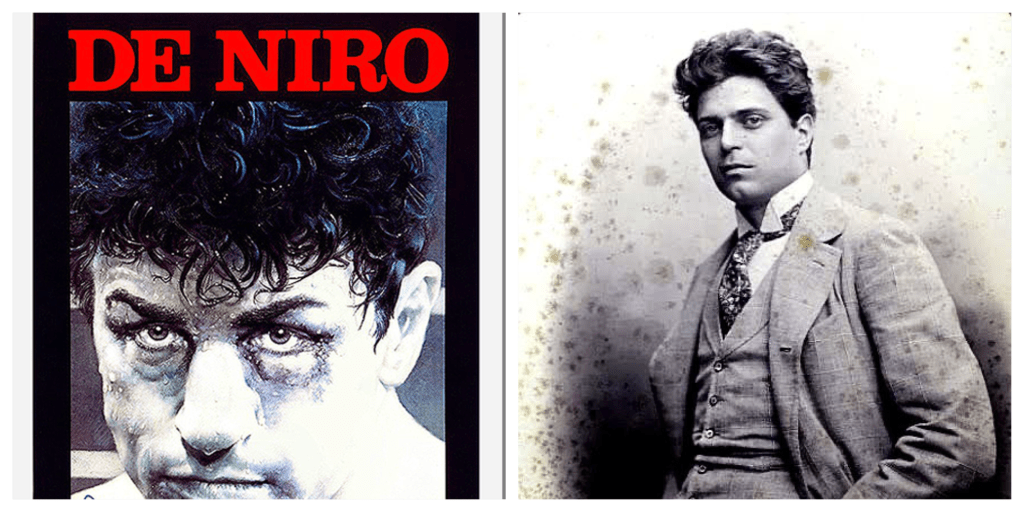
Raging Bull is a 1980 American biographical sportsdrama film directed by Martin Scorsese and starring Robert De Niro, Joe Pesci, Cathy Moriarty, Theresa Saldana, Frank Vincent, and Nicholas Colasanto in his final film role. The film is an adaptation of former middleweight boxing champion Jake LaMotta’s 1970 memoir Raging Bull: My Story.
The juxtaposition of the physical drudgery and tragedy of Robert De Niro’s portrayal of boxer Jake LaMotta, balanced against the supremely romantic and indulgent nagging of Mascagni’s Intermezzo, has to be one of the greatest in cinema history.
Director Martin Scorsese is known for using pop music which fits the time and place of his films, so for him to make such a feature of a major piece of operatic repertoire was a gamble in 1980 – one that has had indelible effect on music and cinema history.
Although he wrote more than a dozen other stage works, Pietro Mascagni is almost entirely known for his first opera, Cavalleria rusticana.
Cavalleria rusticana is musically gorgeous, dramatically gripping, and slyly inventive, as well as historically significant.
Often performed with Il Pagliacci, an Italian opera in a prologue and two acts, with music by Ruggero Leoncavallo.
Mascagni’s life makes for a great rags-to-riches story. He was born in Livorno, Tuscany, the son of a baker.
In 1883 he entered the Milan Conservatory where he was roommates with a young Giacomo Puccini, but dropped out two years later to become an itinerant conductor.
An advertisement in a musical periodical in 1888 would elevate Mascagni from this provincial obscurity.
The publisher Edoardo Sonzogno was sponsoring a contest for ‘an opera in one act—in one or two scenes—on an idyllic, serious, or comic subject of the competitor’s choice.’
It must have been a relief on February 20, 1890, when he received a telegram advising he was a semi-finalist, chosen from among 72 entries.
Mascagni traveled to Rome to demonstrate the opera for the competition jury, playing it on the piano and singing all the parts with help from the panelists.
He made the final cut, which resulted in a premiere at Rome’s Teatro Costanzi on May 17.
The first performance played to a half-empty house, but the small audience raved about what they’d seen, and Mascagni won the competition.
The theatre quickly added 13 more performances, and soon the opera was being performed all across Italy as well as internationally, from St. Petersburg, to Budapest (conducted by Gustav Mahler), to London, to Philadelphia, to Buenos Aires. Mascagni was a celebrity, and in 1896 he left the little town of Cerignola for good.

The profoundly implausible but deeply enjoyable Mission Impossible movies took a step into the concert hall with 2015’s Rogue Nation – an entire scene of the film hinges on and works around a performance of Puccini’s Turandot in a famed action sequence at the Vienna State Opera.
The entire piece is a callback to Alfred Hitchcock’s The Man Who Knew Too Much in which an assassination is planned at the Royal Albert Hall.
In Mission Impossible, the plot of the sequence also revolves around an assassination attempt during a performance of Turandot.
Turandot proves to be a solid choice overall mainly because director Christopher McQuarrie doesn’t need to set up the climax for audiences; Nessun Dorma is such a fixture of popular culture that they can guess where the big gunshot is going to happen.
And with that we get to experience 10 full minutes of Turandot with tenor Gregory Kunde and soprano Lise Lindstrom.
Giacomo Puccini is one of the most celebrated composers in the history of opera. An immensely popular composer during his lifetime, Puccini’s operas continue to be beloved by audiences around the world.
Born in Lucca, Italy, Puccini lived in Italy for the duration of his lifetime, though his operas enjoyed international success during his tenure.
His best known works are among the most frequently performed operas in the world, including La Bohème, Tosca, and Madama Butterfly.
Puccini is famous for writing rich, lush orchestrations and gorgeous melodies that soar in to the hearts of the listener.
His operas are composed with realistic characters, and frequently portray the heroine as a tragic, compassionate figure who must sacrifice everything for the sake of love.
Giacomo Puccini wrote 12 operas in total.
Frequently composing in the Italian realism style of verismo, his most popular operas are La Bohème, Tosca and Madama Butterfly.

Oliver Stone’s Vietnam epic, Platoon, is in the same manner as Apocalypse Now, imbued with a wider meaning thanks to its association with classical music – in this case, the sonorous and affecting strains of Samuel Barber’s Adagio for Strings.
The music has become so synonymous with the image of Willem Dafoe kneeling in the mud that it’s gone beyond pop culture reference point and is often parodied, perhaps the clearest evidence that Barber’s enduring work was always destined for life beyond the concert hall.
Barber’s Adagio for Strings was given an entirely new relevance for a whole new generation, through its superb, slow-motion setting in Oliver Stone’s 1986 modern classic.
The film is an intense drama that examines the fight between good and evil among an American infantry platoon in the jungles of Vietnam and is hailed as one of the greatest war films ever made.
Writer/director Stone draws on his own first-hand experiences of the Vietnam War and takes a close look at the life of foot soldiers, as seen through the eyes of a new recruit.
A massive box office success, Platoon gave Stone his first ever Academy Award for Best Director as well as going on to win Best Picture.
Samuel Barber is considered one of the most expressive representatives of the lyric and Romantic trends in 20th-century classical music.
In 1924 he entered the Curtis Institute of Music in Philadelphia, where, in addition to piano and composition, he studied singing and conducting.
His style was distinctive and modern but not experimental.
He established his reputation with his overture to The School for Scandal (1933), based on Richard Sheridan’s comedy by that name, and with Music for a Scene from Shelley (1935), inspired by the poet Percy Bysshe Shelley’s Prometheus Unbound.
In 1936 Barber composed his String Quartet. Its slow movement, arranged for string orchestra, was performed under the title Adagio for Strings by the NBC Symphony Orchestra under Arturo Toscanini in 1938 and acquired extraordinary popularity in the United States and Europe.
But it was only when Oliver Stone reused it to renewed and dramatic effect in Platoon that it was brought to a mass audience.
The incredible slow-mo images of the torching of a Vietnamese village gave Adagio for Strings an entirely new relevance, with Barber’s violins echoing the screams of lost souls and the brutality of war.

Apocalypse Now is a 1979 American epic war film produced and directed by Francis Ford Coppola.
The screenplay is loosely inspired by the 1899 novella Heart of Darkness by Joseph Conrad, with the setting changed from late 19th-century Congo to the Vietnam War.
The film follows a river journey from South Vietnam into Cambodia undertaken by Captain Willard (Martin Sheen), who is on a secret mission to assassinate Colonel Kurtz (Marlon Brando), a renegade Special Forces officer who is accused of murder and presumed insane.
The most memorable quotation, by far, is the helicopter assault where the cinematic similarities between Brünnhilde’s kin and the Vietnam-era war machines is both stunning and troubling.
The music comes from Act III of Die Walküre begins with the image of a rocky mountaintop flanked by storm-driven clouds.
All of Brünnhilde’s Valkyrie sisters wait there in full armor, ready to perform their noble duty—the transportation of fallen heroes to Valhalla on their winged steeds.
What follows for the next several minutes is perhaps the most popular music Wagner ever wrote and is certainly still among the most beloved orchestral opera excerpts ever written by anyone.
The Ride of the Valkyries is most often heard today in its shorter instrumental iteration, but the operatic version includes the passionate war whoops of the sisters as they scan the mortal battlefields below.
It makes for an incredibly exciting listening experience in a live performance and, in the hands of a great director, the dramatic visual possibilities are nearly endless.
It is impossible to discuss the Ride of the Valkyries without mentioning how frequently it appears in modern popular culture. Aside from Apocalypse Now, the music can be heard in video games, advertisements and television shows. Quite simply, this music is everywhere.

Leave a comment