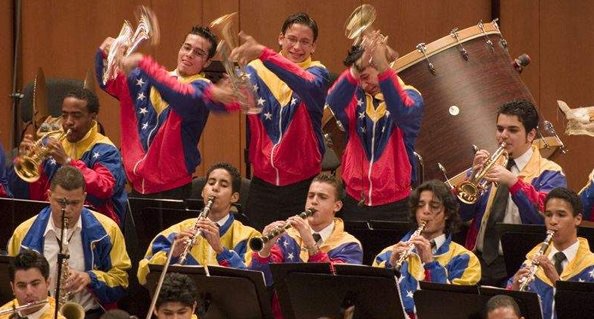
Few music‑education initiatives have attracted as much international attention as El Sistema, Venezuela’s publicly funded network of youth and children’s orchestras. Founded in 1975 by José Antonio Abreu, the programme was built on collective music‑making intended to foster discipline, social belonging, and opportunity. Its story—Abreu gathering 11 young musicians for an initial rehearsal in Caracas—has become emblematic of his belief that ensemble music could spark social transformation by cultivating teamwork and purpose.
A radio broadcast, produced for RTHK Radio 3, is now available on Soundcloud. Musical excerpts in the programme include:
Alberto Ginestara (1916-1984)
Estancia: Farm Workers (Los trabajadores agrícolas) (1941)
Simon Bolivar Youth Orchestra
Gustavo Dudamel (conductor)
Pedro Eustace (b. 1959)
A mi hermano José (2004) – To My Brother José
Pedro Eustace (flute)
Arturo Márquez (b. 1950)
Concierto de otoño: III. Conga de Flores (2010) – (Autumn Concerto III. Conga of Flowers)
Sinfónica de Minería
Pacho Flores (trumpet)
Paul Desenne (1959-2023)
Quinteto del Pájaro II: Guada del borrachito (1981–1983) – Bird Quintet II: The Stream of the Drunk Little Heron
Paul Desenne Ensemble
Leonard Bernstein (1918-1990)
West Side Story: Mambo (1957)
Simon Bolivar Youth Orchestra
Gustavo Dudamel (conductor)

By the 1980s and 1990s, El Sistema had expanded into a nationwide network supported by sustained government funding. Its flagship ensemble, the Simón Bolívar Youth Orchestra, toured internationally, performed in major venues, and earned widespread acclaim. The programme’s model—free or subsidised instruments, regular rehearsals, and a strong emphasis on ensemble playing—was widely praised for promoting inclusion across socioeconomic backgrounds.

El Sistema’s influence now extends far beyond Venezuela. More than 60 countries host programmes inspired by its core principles of inclusivity, collective music‑making, and social development. In the United States, Youth Orchestra Los Angeles (YOLA) was launched by the Los Angeles Philharmonic in 2007 and provides free instruments and instruction to underserved communities and currently serves around 1,700 young musicians. Its success has encouraged similar initiatives across the country and is closely associated with the Los Angeles Philharmonic’s Music Director, Gustavo Dudamel, a central figure in El Sistema’s international profile and an alumnus of the programme who is now scheduled to become Music and Artistic Director of the New York Philharmonic in the 2026–27 season.

In the United Kingdom, The Nucleo Project, founded in 2013 in North Kensington, offers free, ensemble‑based music education in areas facing significant deprivation. It has taken on several national initiatives previously associated with Sistema England, including leadership programmes and instrument‑donation schemes. Across Europe, countries such as Sweden, Spain, and Portugal have adopted El Sistema‑inspired approaches that emphasise inclusion and community engagement. In the early 2010s, the nonprofit Sistema Global was established in the United States to support and connect these international efforts through resources, training, and advocacy.
Although the Simón Bolívar Symphony Orchestra has become a cultural ambassador for Venezuela, El Sistema has long attracted critical scrutiny. Scholars question whether the programme consistently reaches the most disadvantaged communities and whether its claims of social transformation are supported by independent evidence. Critics argue that its organisational structure can be hierarchical and undemocratic, offering limited input from students, parents, or local communities—concerns that have led to allegations of nepotism.

Some educators contend that El Sistema’s strong emphasis on European classical repertoire risks marginalising Venezuela’s folk traditions and may limit students’ creative development. Rapid expansion has also raised questions about quality and sustainability, with reports of uneven resources and training across regional centres. In Geoffrey Baker’s influential study El Sistema: Orchestrating Venezuela’s Youth (2014), he argues that the programme’s international reputation can obscure deeper issues of inequality and that success stories are sometimes amplified for political or fundraising purposes.

El Sistema’s relationship with the Venezuelan state has been both a source of strength and controversy. Public funding has enabled the programme to scale rapidly, but it has also tied its fortunes to political agendas. During the Hugo Chávez era (1999–2013), El Sistema received unprecedented support, with significant investment in local music centres. Chávez publicly admired Abreu and framed the programme as part of his broader social mission to expand cultural access.
Supporters maintain that El Sistema’s goals are fundamentally nonpartisan, focused on social change through music rather than political alignment. Critics, including Baker, argue that reliance on government funding has made the programme vulnerable to politicisation, with successive administrations using it to project cultural vitality during periods of economic and political strain.

Under Nicolás Maduro, El Sistema’s ties to the government became increasingly contentious. In 2017, Gustavo Dudamel condemned the killing of young violist Armando Cañizales during anti‑government protests—a rare public intervention that drew international attention. While Dudamel criticised state violence, he generally avoided direct denunciations of Maduro or Chávez, a stance that has been interpreted variously as diplomatic restraint or insufficient opposition to political interference.

El Sistema has produced a remarkable cohort of musicians who have achieved international prominence: Pacho Flores (b. 1981), trumpet virtuoso celebrated for his technical brilliance and collaborations with major orchestras; Diego Matheuz (b. 1984), conductor and violinist associated with the Simón Bolívar ensembles and a frequent guest conductor with leading orchestras; Rafael Payare (b. 1980), conductor and former trombonist, Music Director of the San Diego Symphony and former Music Director of the Ulster Orchestra (2014–2019); Pedro Eustache (b. 1959), multi‑instrumentalist, composer, and instrument maker known for his versatility and world‑music performances; and Paul Desenne (1959–2023), cellist, composer, and educator, a founding member of the Simón Bolívar Youth Orchestra and acclaimed for blending Venezuelan folk idioms with contemporary classical language.

Despite ongoing debates, El Sistema has profoundly shaped the lives of hundreds of thousands of young people. Its combination of musical rigour, collective practice, and social aspiration has inspired new movements worldwide and produced musicians who now shape the global classical landscape. At the same time, its story illustrates the complex intersection of art, education, and politics—an intersection that continues to evolve as the programme navigates questions of independence, equity, and long‑term sustainability.
This article was researched using primary and secondary sources with the assistance of Vibe AI. The research was cross-checked for accuracy.



Leave a comment